Document Distribution System:
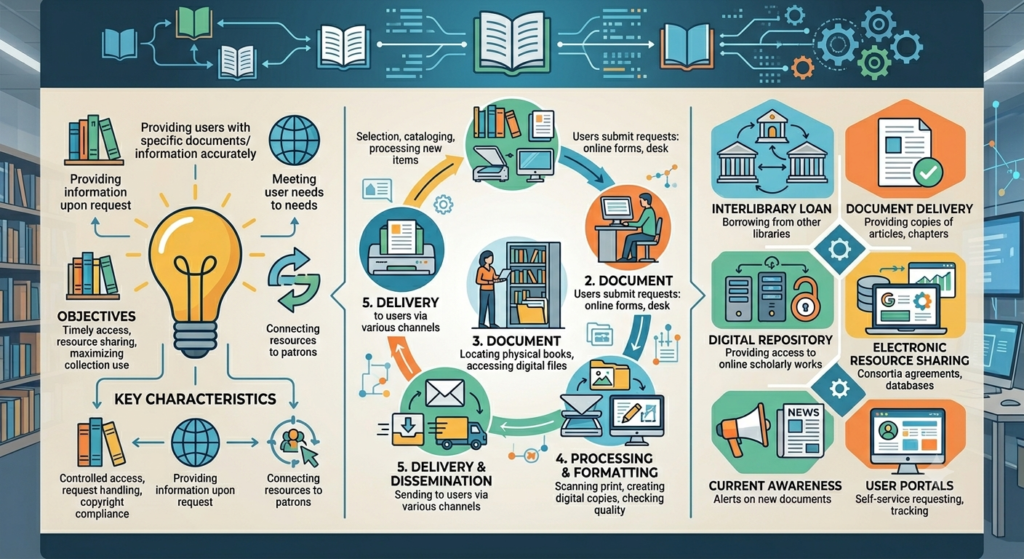
The terms “document” and “information” are derived from the word “documentation,” which is recognized as a process. This process highlights the importance of information in the advancement of civilization. In today’s world, an immense amount of information is published daily, making the challenge of selecting relevant information from this vast pool increasingly significant. As a result, an effective document distribution system has been developed. Scientists and researchers often lack the time to sift through the overwhelming sea of information, underscoring the need for such distribution systems.
What is information:
A document delivery system defines a document as any printed material or information that can be transmitted by various devices or other means.
What is meant by information distribution system:
All the things that can be read, considered or all the learning resource documents that are in the library are distributed for the benefit of the public and the method of distribution is called documents delivery system.
Ways to provide effective information distribution services
1) How information is created:
When a work is decided through discussion, information is created. Which is created through human skills and experience. Then it is printed and other types of information are created.
2 ) What are the types of information
Documents are generally of two types. However, they are generally of two types. Namely -A) Printed
B) Mechanical
A) Printed: Here are books, newspapers, magazines, etc. printed materials.
B) Mechanical: Computer, microfilm, microfiche, video conference, other digital methods, etc.
3 ) How can information be processed:
Information can be processed in various ways. In the case of libraries, cataloging, classification, filing, typing. Catalog cards, abstracts, indexing, and bibliography are processed through which it is possible to provide effective document services.
4) How to store information:
There are two types of storage methods –
- Storing of bibliographic information such as students’ names, father’s names, addresses, etc.
- b) Storage of Materials in Original: Here the number of students in the classroom, which books are in the library, which are outside, etc. can be kept track of.
5) How to retrieve information:
This is somewhat related to the previously discussed stored information. It is also generally of two types. Namely –
a) Retrieve of Bibliography information: Such as the name of the book, author, publication, etc.
b) Retrieve of Original Document: The original information is entered here.
6) What information to provide:
Here it will be mentioned what information can be provided and which cannot be provided. That is, which books can be provided and which cannot be provided.
7) To whom the information must be provided:
Who will have to provide this service will depend on the type of institution/organization. We have to start from the type of institution, i.e. for whom it is prepared. Here, by itself, we mean the official officers and employees. Then this service will have to be provided to other honorary institutions.
8) How to distribute:
Action plan can be done in various ways, information can be provided through Exgistion postal system by hand or hand received etc.
9) Why to distribute:
We have to provide our own interests. To provide services, to perform duties, and also to provide other information to others, it is possible to gather information from others.
10) In cooperative method:
Here it is possible to exchange information through mutual cooperation. Because if you give, you will get, there must be a mutual agreement for exchange of information. For example, if you have to provide resource sharing services between two universities, no matter how it is.
11) Preservation and distribution
It should be provided to other prominent libraries from where it is received in the world and it should be modified through learning resource sharing over the years.
Information distribution method:
Documentation is perfected through the application of human talent and skills of modern technology through the information explosion. The accuracy of documentation work and services lies in distribution. Even if information is converted into any new state, form and language and information is adjusted to the needs, a distribution system has to be adopted.
Modern documentation system uses human talent, labor and skills and mechanical art techniques in healthy distribution. The techniques / means that need to be adopted to ensure healthy and normal distribution of documentation services are as follows:
1. Patent: This was born in 1852. A patent is a written agreement between the government and the researcher. In this, a third party can publish it and use it through royalty. It can be recognized in any country. Patent plays an important role especially in the field of technical, chemical and pharmaceutical discoveries.
2) Standards: This method is very useful for businessmen. It can be of various types. However, standards are very important for any decision regarding technical, commercial organization methods, measurements, terminology, etc.
3. Current Awareness Services: Among the modern information organization and service processes, Current Awareness Service Information Service is considered as the most important and effective method. It is not possible for a researcher to be aware of all the information in his/her field of research in any way in a single effort at present. However, he/she must know this information to conduct research. New research can be repeated. Moreover, modern needs are very important in every field of research. That is, a researcher needs to know what kind of work is currently being done on his/her own subject and where and who is working on it.
On the other hand, Indexing and abstracting journals/periodicals published on a given subject provide guidance on all the important articles in the field. But they also need time to be published. After the publication of the periodical, an interim arrangement is taken between the inclusion and publication period in indexing and abstracting periodicals. And this arrangement is called the current awareness service.
4. Selective Dissemination of Information service: The service provided to a specific researcher or user based on specific needs instead of general service from the current database is called the Selective Dissemination of Information. Hans Peter Luhn first expressed the idea of this method in 1958. He is also famous as the proponent of the KWIC index in the field of indexing. Therefore, the service that has been created with each researcher’s needs in mind is called Selective Dissemination of Information.
Its functions are of various types, such as-
a) User profile and document profile
b) Matching
5. Notification: In this method, the reader can find out about the information he needs. The important words of the information are keyword, abstract, etc.
Its functions are of various types, such as-
a) User profile and document profile
b) Matching
5. Notification: In this method, the reader can find out about the information he needs. The important words of the information gathering are keywords, abstract, etc.
6. Feedback: Just telling the reader about the information is not enough. It is also necessary to find out how much it was useful to the reader or whether it was of any benefit to him at all. In order to be careful about the information, the reader is asked on a card whether the information provided will be of any use to him. In addition, the reader and the researcher are asked whether the document citation is sufficient or a copy of the abstract is required. Providing information by considering all these aspects can yield very good results.
7.Reprography: The word Reprography was first invented in Holland around 1950. According to G.H, Wright, this method was first used in 1954. Earlier, in ancient times, there was a rule of copying by hand. As a result, it was not possible to make more than one copy by hand. Because after the invention of paper, there was a system of copying 6/7 or even more copies at a time. Then the word Reprography came from re production and photography. It is possible to distribute information to make one or more copies with the help of photocopying. And this one or more copies is called Reprography.
Additionally, various information services can be provided through multiple communication methods, including bibliographic services, documentation cataloging, indexing, abstracting, cataloging and classification, translation, page maintenance, retrieval services, computer-based information distribution, instruction services, and newspaper indexing.