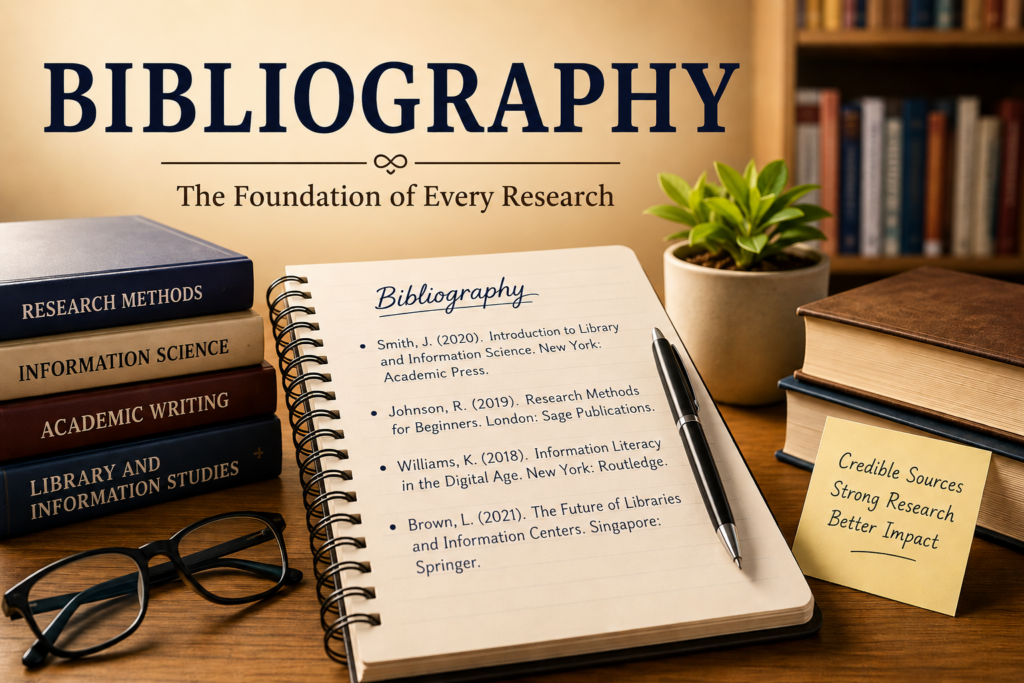
A bibliography is a list of books or related informative materials used by the author in writing an article, a book or a thesis, arranged according to a pre-defined plan.
The definition used for bibliography here is just a kind of small-scale use of bibliography. In the real sense, the meaning and use of bibliography is more comprehensive, extensive and far-reaching. In the broad sense, the goal of the publishing world is to provide all the differentiation and supporting information, the overall universal list is called ‘bibliography’. But those who use bibliography from the perspective of writing, and the bibliography is helpful and helpful in that regard, and the list presented in a regular manner can be limited to the name ‘bibliography’.
Importance of Bibliography in Research and Academic Writing:
A writer, researcher, composer can take the help of multiple sources in multiple ways to create his desired context. Among them may be general and reference books, periodicals, daily newspapers, etc. If an author collects information through previously published publications and based on that, writes a painstaking research paper or if he has interviewed various people, the names of those who have been interviewed will also be included in the bibliography or acknowledgements. It should be noted here that the manuscript editor has to be more aware than the authors. Because an author can make mistakes in acknowledging information due to haste, excessive pressure of writing, or mental stress. But the editor should not make mistakes. He has to be calm, intelligent and has rich experience in using different parts. Then he can correct the mistakes of the book writer/author/researcher/editor and completely eliminate the manuscript.
Purpose of compiling a bibliography
The purpose of preparing a bibliography is to assist everyone as much as possible. It is important to remember that a bibliographer compiles a written list of all the sources consulted while preparing their work. The manuscript editor will carefully review each entry to ensure that the name is included in the bibliography and that the information provided is accurate and complete.
Where should the bibliography be located?
A writer uses multiple sources of information in his writing and acknowledges it in multiple ways. If you look at various books of international standard, you will see that in some books, each chapter has a bibliography at the end. In some books, the bibliography is placed at the end. You will find some books that follow both methods together. Manuscript editors have a very good experience in this regard. For those who are new to this field, it can be said –
- Some libraries maintain a separate list of supporting books for each chapter, which is included at the end of each chapter. This is referred to as the End of Each Chapter.
- Someone else adds a comprehensive list of all the books or resources they used to write the entire book.
- Some authors include a bibliography at the end of each chapter. It is also valuable to have a consolidated list of all the source books used throughout the book. However, some editors may be less meticulous in this regard, as they want to avoid any mistakes. Therefore, the manuscript editor must analyze these aspects very carefully.
How many types of bibliography can be included in a book?
A librarian, researcher, or essayist can take help from many sources to write his book, research paper, or essay. These include –
A. Books – general and reference books, encyclopedias, dictionaries, etc.;
B. Manuscripts – manuscripts of unpublished books;
C. Thesis – theses, research papers, dissertations, etc. written by various researchers.
D. Periodicals;
E. Daily newspapers
F. Bibliography, index, calendar, guide, government publication, booklet etc.
If the list of these sources is long, then each group is separate and if it is small, then it is better to enrich it together. Even if the list is grouped together, there is no obstacle to identifying the groups as A, B, C. .. etc.
General rules for preparing a bibliography:
There are many rules and methods for preparing a bibliography. A writer, researcher or manuscript editor follows one of the rules. He will decide in advance what the form and form of the bibliography he is preparing will be. Gene Key Gates said in this regard:
1. All bibliographical entries must be in accordance with the purpose of the research paper.
2. All items must be presented accurately, clearly, and logically.
3. The bibliographical form which is prescribed for a given paper must be followed consistently in every entry.
Before writing a bibliography, the bibliographer must ensure that certain features are consistently observed. If librarians, researchers, and manuscript editors pay close attention to these aspects, they can avoid mistakes in their respective fields.
Required items for bibliography:
1. Author’s name –
2. Title of work –
3. Edition (excluding first edition) –
4. Total number of volumes in the set (if the entire set is used) –
5. Place of publication, publisher’s name and publication date –
6. Number of pages in the book –
Bibliography is an essential tool for identifying, organizing, and verifying the sources used in academic and research writing.A well-prepared bibliography provides accurate and complete information about the sources and enhances the credibility of the work.Therefore, writers, researchers, librarians, and editors should follow consistent bibliographic rules to ensure clarity, accuracy, and usefulness.