The lexical meaning of the word pruning is to give up, to eliminate or to remove. In the case of libraries, pruning of library materials is to eliminate or to remove unnecessary books and other reading materials. Almost every book in the library loses some of its contents due to repeated use and becomes unusable. On the other hand, due to the purchase of new editions of the same book, the old editions lose their usefulness in use. In addition, due to the continuous collection of new books, there is also a shortage of space in the library. For all these reasons, it is inevitable that pruning of library materials sometimes becomes necessary. In other words, it can be said that pruning of library materials is to remove or to remove unnecessary and unsuitable differentiation from the collected reading materials in order to maintain the dynamism, liveliness and modernity of the library.
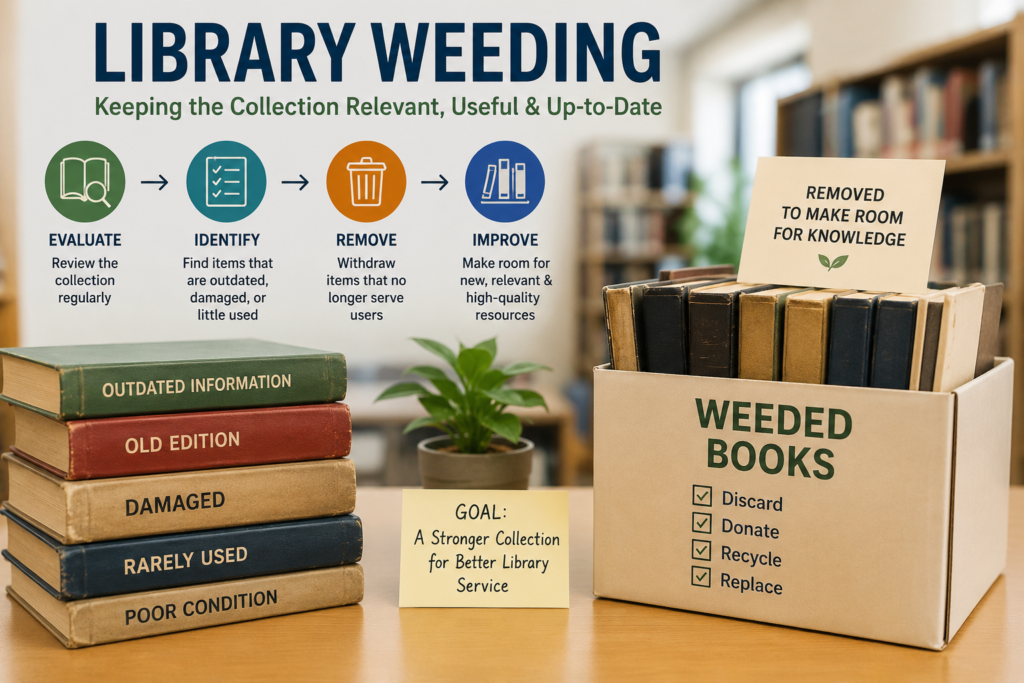
According to Jeanette Larson, weeding is the systematic removal of resources from a library based on selected criteria; it is the opposite of selecting material. Through the selection and deselection of material, using the same thought process, weeding is a vital process for an active collection because it ensures the collection stays current, relevant, and in good condition. Weeding should be done on a continuous, ongoing basis.
According to the ALA Glossary, “Library weeding is necessary from time to time to maintain high standards. Just as harmful and unnecessary dead branches must be removed to preserve the life of a tree and increase its lifespan, so too, unnecessary books must be pruned, sorted, and cleaned to keep a library simple and lively.”
Weeding Policy:
Weeding books is a regular task of the library. Because to keep the library alive and vibrant, there is no alternative to weeding out unnecessary and unusable books. But to carry out the weeding work in a healthy and efficient manner, it is necessary to follow a policy. Below are the principles of weeding books following Dewey’s table of knowledge and science:
1. General Knowledge: Books focused on general knowledge and current events typically have a relevance span of one to five years. As time passes, the demand and significance of these books diminish. Once the information is outdated, they no longer serve as reliable materials for writing history. Therefore, after compiling the most recent editions of these works, necessary updates can be easily implemented.
2. Encyclopedia: Care must be taken when collecting encyclopedias, as most librarians cannot afford to purchase them repeatedly due to the large number of volumes involved. However, if new editions of the encyclopedia can be acquired, and the library is mobile or not fixed in one location, then it is possible to gather older editions as well. For example, if a library collects only 33 volumes of the Encyclopaedia Britannica, it may be feasible to manage without acquiring the old editions.
3. Philosophy and Religion: Books on philosophical doctrines and religious books such as the Quran, Hadith, Bible, Gita, etc. cannot be removed. However, it is better not to have books containing radical religious debates in the library. These books must be removed.
4. Social Sciences: If the books on sociology, political science, economics, statistics, etc. are old, the old editions can be trimmed, subject to the new edition being published. However, books on law and ideology should not be trimmed.
5. Linguistics: Linguistics books, history of various languages and critical books cannot be weeded. However, if a new edition of the same book is published and it is collected by the library, the old edition can be weeded.
6. Science and Technology: If new revisions are collected in books on science other than mathematics, it is necessary to prune the old editions. The importance of new editions of books on the theory of science is always greater. Because in that case, the theory and information change considerably in the new edition. Therefore, when new editions of these subjects are available, the old ones should be pruned. It is mentioned that the lifespan of these books should not exceed 10 years. The same is applicable to proposals on science and technology, including medicine, and even agriculture.
7. Fine Arts: Fine arts books are the carriers of civilization and creation. They are used as elements of history. Therefore, it is better not to lick fine arts books for future use.
8. Literature: This category includes books such as poems, plays, novels, and essays that possess literary value and are best kept outside the umbrella of classic literature. However, works that lack literary merit and are authored by unknown individuals may be discarded. Well-known literary titles that are damaged from excessive use often have limited value over time; in these cases, new editions can enhance the library’s collection. Thus, the library can refresh its offerings by acquiring new editions while also considering the renovation of older ones.
9. History, Geography and Biography: The value of books on the history, geography and biographies of famous people of any country or region is immense, and the information in the national book is not subject to change, so such books cannot be weeded.
10. Reference: Books like calendars, yearbooks, handbooks etc. are published regularly and old copies can be weeded out subject to collecting new copies.
11. Books by local authors and any books by authors in the area where the library is located or books related to local resources cannot be weeded out.
12. If a book on any subject in the library is torn, infested with insects and becomes unusable and the cost of the book is higher than the actual value, it is better to weed out the damaged book and buy a new book.
Weeding Method:
The library book weeding method is outlined below.
1.In small libraries with limited collections, weeding is often unnecessary unless there are specific reasons to do so. However, in large libraries, it is important to evaluate which books should be kept. Before proceeding, approval from the appropriate authority should be sought, along with a clear justification for the decision to weed.
2. Subject to the approval of the authority, the books to be trimmed should be carefully separated from other books in the light of the policy.
3. A complete list of the books to be trimmed should be prepared. The list must mention the accession number, author, title, edition, year of publication, publisher, source, price list of each book.
4. After preparing the list, the prepared book list should be presented in the document for the written approval of the authority.
5. After the authority gives permission for trimming, the catalog cards and shelf list cards of the trimmed books should be removed from the cabin.
6. Along with the removal of the catalogue card and self-list card, arrangements should be made to keep the pruned books in a separate place.
7. Later, the word ‘pruning’ should be written or sealed in the remarks column opposite the expression number of each pruned book in the inclusion register.
8. With the approval of the authorities, the pruned books can be donated to any other library. Apart from this, arrangements can also be made to sell them through auction or burn them.
9. In the event of a layoff, arrangements must be made to preserve the list of books and the layoff permit documents.
Weeding is an essential library management practice that ensures the collection remains current, relevant, accessible, and in good physical condition. By following a well-defined weeding policy and systematic procedures, libraries can optimize space, improve service quality, and maintain a dynamic collection that effectively meets users’ evolving information needs.