The process of determining the value of a document is known as evaluation standards. Initially, the responsibility for evaluating a document’s value rests with the officers of the relevant offices. Archives in various countries have initiated efforts to assess the value of records. However, these guidelines often fall short in addressing the complexities involved in evaluation, as the content of certain documents is not predetermined. Consequently, these documents cannot be classified as permanent records in advance. Therefore, evaluating these documents requires careful judgment and the application of individual intelligence.
Evidential Value of Government Records and Administrative Documentation
Here a question arises as to why an archivist is so conscious of finding valuable evidentiary documents and preserving them for administrative purposes.
It is natural for an archivist working for the government to focus on preserving all administrative records of the agency. During the evaluation of these records, only a few significant and valuable files are typically identified. Generally, the records document the events and challenges faced by the organization, as the government operates based on these records. The obsolete information repositories within government administration are eventually preserved by national archives, serving administrative needs.
If there is a demand for information while addressing problems or making policy decisions in the current government administration, past documents are referenced and utilized by administrators. An archivist must possess practical experience in assessing the evidentiary value of documents. To effectively fulfill this role, modern archivists require training in relevant areas. It is insufficient to simply state that all records of an organization should be retained. Evaluations must also consider the administrative value as well as the key needs of researchers in various fields, including economic, social, historical, and others.
Key Principles for Evaluating Government Documents
The evaluation of archive documents depends on the type of documents produced by the organization. There is a coordination of work with documents at different levels of a government’s administrative structure or structure. Documents are exchanged with subordinate offices in addition to the main office of a ministry. Among these, the provisions related to policies and decisions are certainly important.
The following points should be kept in mind while evaluating government documentary documents.
A. There should be knowledge of the hierarchy from the highest to the lowest level of the organization;
B. There should be knowledge of the activities of each organization and its subordinate organizations;
C. Various aspects of the organization and its subordinate offices in performing their duties. Document evaluation helps in making decisions on several other issues.
1. For example, the location of the organization from an administrative point of view;
2. The characteristics of the documents in which the organization works;
3. Different characteristics of each organization from the point of view of administration.
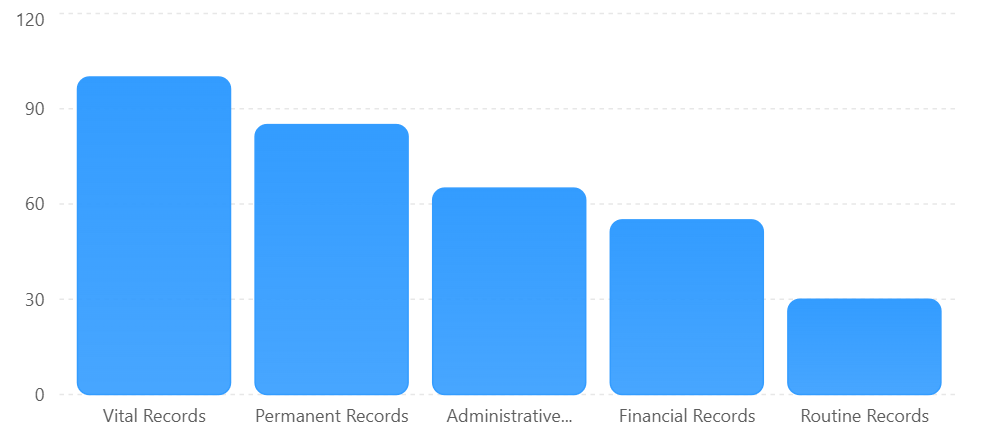
The various service commissions of America have prepared a chart of government documents there. Through this chart, the importance of the documents of any organization has been highlighted.
Below is a simple chart showing the importance of government documents according to the records management schedules prepared by various American service commissions.
Importance of Government Documents
Explanation
Various service commissions in the United States have developed records retention schedules and charts to classify government documents according to their importance and value. These charts help government agencies determine which records must be preserved permanently, which should be retained for a specific period, and which can be safely disposed of after use.
- Vital Records are the most important because they are essential for the continued operation of government and the protection of legal rights.
- Permanent Records have long-term administrative, legal, or historical value and are preserved indefinitely.
- Administrative Records support daily government functions and are kept as long as necessary.
- Financial Records document fiscal activities and are retained according to legal requirements.
- Routine Records have limited value and may be destroyed after their retention period expires.
Such classification systems improve records management, reduce storage costs, and ensure the preservation of historically significant government information.
Types of Archival Documents and Their Research Value
Every organization engages in various types of work, resulting in the creation of different documents. Similar documents are organized into series for better management. By analyzing these documents, one can gain insights into the key events and activities of the organization. This analysis helps determine which documents hold significant value and which are less important. Valuable documents should be evaluated separately from those of lesser importance. Additionally, documents can be categorized in different ways based on their value.
A. “Policy-type documents” refer to various analytical techniques used to implement an organization’s plan. These documents can be categorized into several types:
- Organizational Overview: General information about the organization.
- Origin of the Organization: Details about the establishment and background of the organization.
- Work Plan: A structured plan outlining the organization’s goals and objectives.
- Legal Memoranda: Any special correspondence relating to legal matters.
- Minutes of Meetings: Official records of discussions and decisions made in meetings.
- Correspondence Records: Information related to communication with subordinate organizations.
- Policy Documents: Guidelines and policies governing the organization.
- Manuals or Official Written Correspondence: Documentation outlining procedures and official communications.
- Rules and Regulations: Established guidelines for behavior and operations within the organization.
- Instructions: Specific directives for tasks and activities to be performed.
- Reports: Includes annual reports, seasonal reports, and special reports summarizing activities and findings.
- Conference Minutes: Records of discussions and decisions made during conferences.
This clearer structure will help in understanding the different types of policy-related documents within an organization.
2. Operating Records Officer
This category primarily includes administrative work records. Operating records encompass all the administrative actions taken to permanently implement any office document or decision. Personal documents are also classified as operating records. Additionally, any notices issued to address office tasks or problems are included.
3. Housekeeping Records
Housekeeping records are essential for the daily operations of any office. They pertain to the financial matters managed day-to-day, such as purchasing and property control. While many of these records are temporary, a few are considered permanent and are distributed to all offices and service departments. These records are valuable not only in their current state but also from a legal and administrative perspective.
4. Publications and Publicity Records
Administrative government publications, such as bulletins, government circulars, pamphlets, policies, instructions, and manuals, are extremely valuable and often reflect the significant work of an organization. Publicity related to these government publications refers to instances where information is actively disseminated, including press and radio releases, complete bulletins, media clips, and posters. However, these items do not fall under the category of files because no official file is created for them.
5.Informational Value of Documents
The informational value of documents pertains to the research significance of various government resources. It goes beyond simply identifying the types of records an organization produces or the outcomes of their actions. Research information can be obtained by analyzing and evaluating individual files. Those conducting such evaluations must possess specialized knowledge of administrative matters in order to effectively interpret the research and informational content.
Initially, these experts can successfully manage the research and informational aspects. Evaluations can also be used to preserve evidentiary materials, such as recordings. In specialized fields like science or geography, it’s best for evaluations to be conducted by experts with relevant subject knowledge.
Value cannot be measured by a single standard; it varies with context and time. American historian Smith noted that what may seem like trash or rubbish to one person might be considered valuable to another. A document deemed worthless today could very well become valuable tomorrow.