The Dictionary of Library and Information Science defines a directory as, ‘It is an alphabetical or classified list of individuals, organizations, institutions, etc., in which contact information (name, address, phone/fax number, etc.) and other relevant information (institutional relations, conferences, publications, memberships, etc.) are provided in a concise form and are published almost continuously. Directory can be created on a variety of subjects and can be placed in book form in printed, microfilmed and electronic forms.
History of the Directory
Directory has been compiled for a long time to satisfy people’s curiosity about people or places. Initially, directories were census-type compilations of property or individuals that were prepared by feudal lords for the purpose of calculating wealth and taxes. The predecessor of the written guide was the history books on travel and natural features compiled in ancient times. These books recorded geographical and historical descriptions of various places. The “Itinerary” written by John Leland of England, “The Description of England” written by William Harrison, and “A Survey of London” by John Stow are notable books of this genre, which had great historical and literary value as well as private value. In the middle of the 19th century, urban civilization developed under the influence of the Industrial Revolution. During this time, people’s need to know about various things in far-off places increased. With the development of the telegraph, railways, and telephones, the importance of knowing addresses, schedules, telephone numbers, etc. also increased.
As the number of goods and services increased, the need for directory-type publications became more apparent, the first of which was the “City Directory”. These city directories of the early 19th century were the direct predecessors of today’s descriptive classification. Typically, such directories contained a local gazetteer or a classified list of various business establishments. At that time, libraries became the main customers of such directories. Telephone directories, professional directories, and company directories found their way into library collections. And so directories became an integral part of the library’s reference collection. For most of the 20th century, shelves filled with colorful directories were a familiar sight in libraries.
Since the 1980s, advances in computer technology have led to the increasing use of CD-ROM and web-based directories. With the availability of a wide variety of freely available directories on the web, libraries are now having to rethink the need for expanded directory storage.
Evaluation of the Directory:
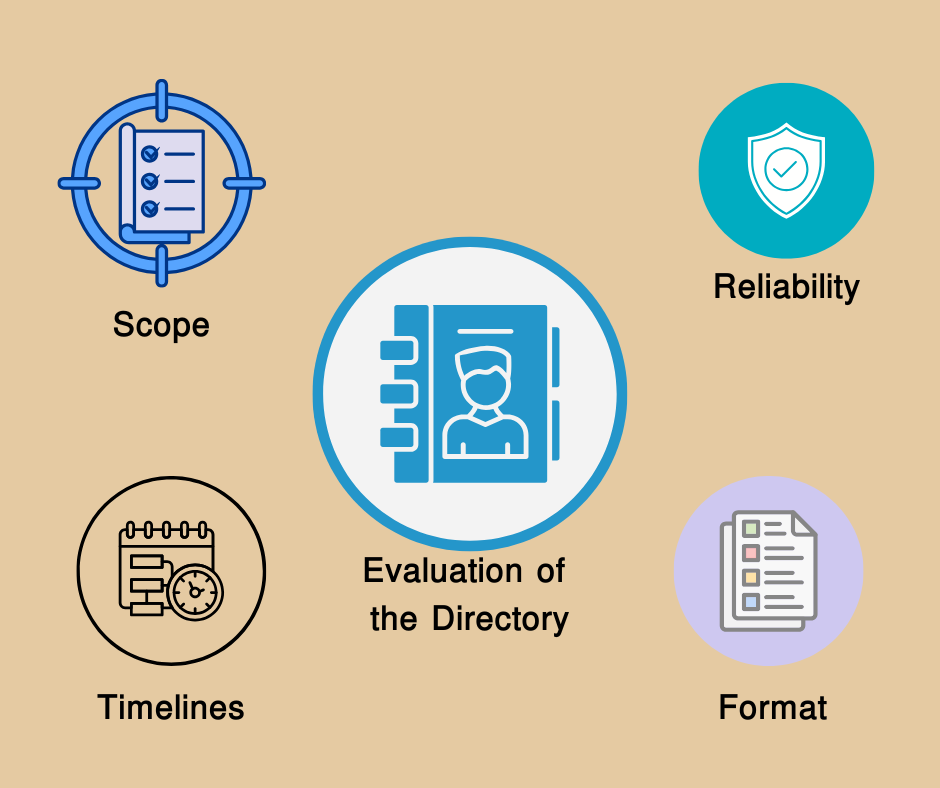
Librarians have always emphasized the importance of evaluating directory materials properly. Most of the criteria for evaluating other referral materials are also applicable to directories. Some of these are discussed below:
1. Scope:
The first criterion for evaluating a directory is to know what information is included in the directory. To judge the scope of the directory, three questions must be answered: ‘Who’, ‘What’, and ‘Where’. One of the ‘Who’ questions is: What types of people are included in this directory? What data is there about them? ‘What’ type of questions include: What type of organization, educational institution, company, business establishment, etc. is this guide basically listing? And ‘Where’ type of questions are characterized by geographical character, knowing whether it is bounded by local, national or international boundaries.
2. Timeliness:
How often is the guide published and updated? Is it published and updated on an annual basis, or on a bi-monthly, quarterly, weekly, or daily basis? Users of the guide typically want to connect with individuals and organizations beyond their own boundaries.They will fail to do this unless the information in the guide is absolutely consistent. While it is easy to determine the contemporaneity of printed guides from the date of publication, it is not so easy in the case of electronic materials. Naturally, electronic materials are updated more frequently than printed materials. However, in many electronic guides, the responsibility is fulfilled by adding or removing some data rather than the entire database. In such cases, the librarian will have to take responsibility to see whether the entire database has been updated or only a part.
3. Reliability:
The reliability of the information provided in the guide should be carefully judged. Is the information given here about individuals and organizations correct? An idea can be found in these by reading the preface and introduction of the guide. Because this part shows the method in which the information in the guide has been compiled. Incorrect information will greatly reduce the acceptability of the guide, and it is the librarian’s responsibility to warn readers about this.
4. Format:
Does the directory have a table of contents? Are the entries categorized or listed alphabetically? Are the subject categories listed at the top of each page? Is the electronic version searchable by region? Answers to these questions are needed to evaluate the format of the directory. The format determines whether the information provided by the directory is easy to use or not. If the internal information format of the directory is not user-friendly, the user will not be able to find information from it easily. However, whether the directory is printed or electronic, the reader will not be able to quickly and effectively find information from it if they have no idea about the method of using table of contents.
Guide Selection of Directory:
Different libraries follow different criteria in selecting guides. In this regard, the type of readers, size of the library, ideals and objectives, etc. play an important role in the library. The criteria in selecting guides include the user, the source and the otherness of the guide. In addition, the librarian also has to carefully select the right material by comparing the commercial guides that require payment against the sources that are available free of charge on the web. The three main criteria in selecting library guides are discussed below:
1.Users: In developing a collection of guides, the intended users must be considered. One of the characteristics of public libraries is that they prioritize guides related to the geographical area in which the library is located. On the other hand, in the case of academic libraries, guides related to the subjects taught and researched in that institution predominate. Similarly, special libraries prioritize the needs of the users of the institution to which they market.
2. Price: The price of a guide is an important factor for any library. The size of the library, its budget and the availability of alternative funding have a direct impact on the selection of guides. Large libraries have sufficient funds to collect comprehensive guides, while smaller libraries usually have to be content with selected parts of large-format printed guides or with electronic versions. In cases of limited funds, free guides and official websites may be useful.
3. Uniqueness: When selecting a guide for library reference collection, it is important to consider its unique features. Does it contain special information that no other guide contains? To find the answer to this question, it is necessary to compare different guides of the same type. There is no point in collecting multiple guides that are almost the same in terms of content. Therefore, one should carefully select a guide that can add special value to the library collection and is also attractive to the reader.
Directories have evolved from simple census-style lists to highly sophisticated print and digital reference tools, becoming indispensable resources in libraries for locating accurate and timely information. As libraries continue transitioning into the digital era, careful evaluation and thoughtful selection of directories remain essential to ensure reliability, relevance, and maximum value for users.