What is Stock Taking in Library Management:
In any organization, it is necessary to check the inventory of the assets at a certain period of time to determine the amount of assets. The assets of the library are books.
Importance of Stock Verification in Library Governance:
In the case of libraries, stock taking is the accounting or stock checking of the books. To check whether the books of the library are in the right place or not, if not, where are they and whether they are being used properly or whether there is any damage to the collected books, it is necessary to reconcile the accounts of the books at a certain period of time. This is an important part of good governance. And this reconciliation is the stock taking of library proposals. Through this, the library staff can be aware of their responsibilities. If stock taking is not done, the library staff does not have accountability. As a result, there is a work style among them. This increases the amount of book loss. Therefore, regular stock taking is very important.
Challenges of Stock Taking in Large Libraries:
Regular stock taking in large libraries is inconvenient. Because during stock taking, the library is closed for some days, thus depriving the users of library services. To overcome this inconvenience, stock taking of books can be done in small batches throughout the year. This can be done by keeping the regular workflow active.
Prerequisites for stock taking:
To carry out any work properly, prior planning and some prerequisites have to be followed. This is equally applicable to stock taking of books in the library. The prerequisites for stock taking are mentioned below:
1. First, the approval of the authority has to be taken and the authority can give the order for stock taking.
2. The date has to be fixed for stock taking.
3. The library members including all the concerned should be informed by giving a notice mentioning the fixed date so that they can submit the issued books on time.
4. Arrangements should be made to close the reader service and book lending activities during stock taking.
5. A meeting should be held to decide in which method the stock taking will be done.
6. An order should be issued regarding which officer and employee will complete the stock taking.
7. The necessary materials for stock taking work such as paper, pen, pencil, rubber, mask, duster etc. should be collected to get rid of dust. Moreover, if stock taking is done according to the accession number, a seat with the accession number should be prepared in advance.
8. It should be ensured that no outsider can enter the room while taking stock.
If the mentioned conditions are fulfilled properly, it may be possible to take stock correctly and accurately.
Methods of stock taking:
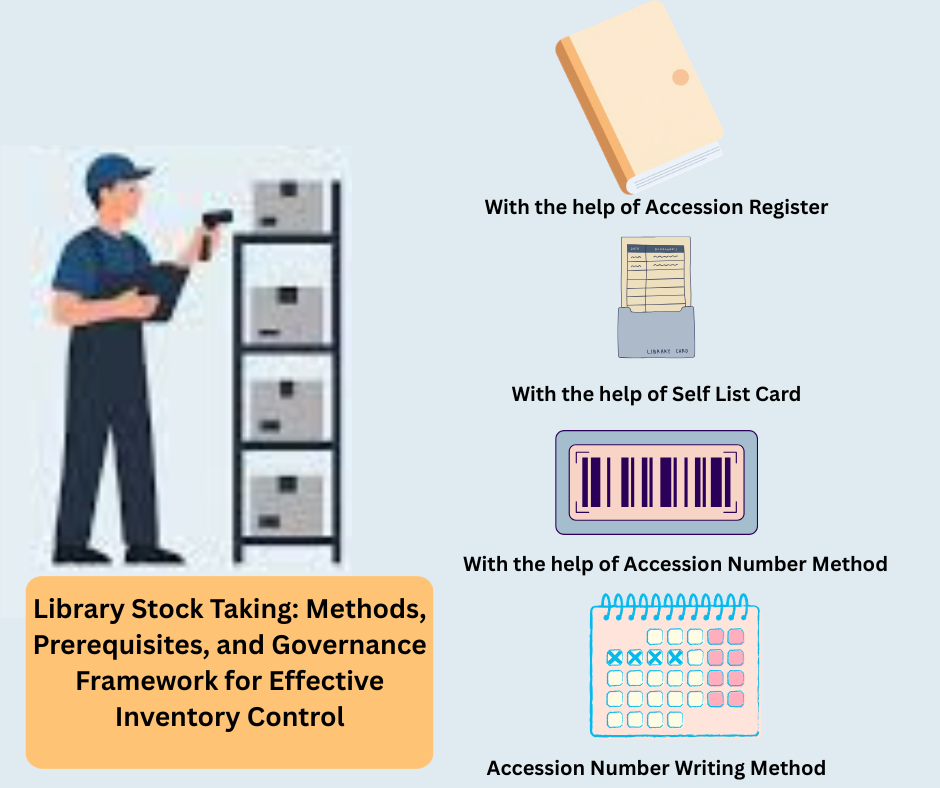
There are various methods in use for accounting or stock taking of library books. Namely –
1. With the help of Accession Register
2. With the help of Self List Card
3. With the help of Accession Number Method
4. With the help of Accession Number Writing Method
1. With the help of Accession Register:
In this method, the Accession Registers are taken to the shelf. After looking at the last book, one will say the Accession number of the book and R. One will find the Expression Register and put a check mark (√) next to the corresponding number with a pencil. When all the books are examined in this way, the numbers in the Accession Register that are not checked will be compared with the previous lost list, the cut list used to see if any book has been lost or rejected. Finally, a list of the numbers in the Expression Register that are not checked will be prepared and the books in this list will be marked as old books.
Advantages and Limitations of the Accession Register Method:
This method may seem simple at first glance, but it is not very clean. Because the books are not arranged on the shelves according to the accession number. As a result, the name of each book is called from the shelves and the colleague has to repeatedly turn the pages and tick the books. This wastes a lot of time. Moreover, ticking the accession register year after year spoils the beauty and longevity of the register. Therefore, this method is not very effective.
2. With the help of shelf list cards:
In this method, the drawers of shelf list cards arranged according to the postal number (call number) are taken to the book shelf as before. One worker will say the name of the book, call number or accession number from the card and another will find the corresponding book from the shelf. In this way, the card that is found will remain properly in the tray and the card that is not found will have to be turned over and kept standing. Then the issue counter, previous lost list, list of obstacles or layoff list etc. will have to be checked. In this way, after the check, only the cards that are finally standing will be marked as lost books. These cards will have to be taken out of the tray and a separate list will be made. Along with this list of lost books, a proposal for rejection will have to be submitted to the authorities. The authority will issue a written order to reject the lost books as per the rules. The rejection order and list must be properly preserved in the records.
3. Accession number method:
In this method, all the accession numbers of the books in the Accession Register should be written on a white paper starting from 1 in numerical order or printed on a computer. It will be convenient to make a few copies by photocopying them. Then, the number of shelves in the library should be calculated and divided. Two workers will work on each shelf. One worker will take the book from the end and say the accession number and the other will tick or cross out the numbers written on the white paper accordingly.
In this way, if the accession number of all the books is ticked or crossed out, the issue counter, the list of previous lost books, the list of blocked books and the list of cut-off books should be checked. Finally, the posts whose numbers are not ticked or crossed out on the white paper will be marked as lost proposals with phone numbers. A separate list of all these lost books should be created. Below is a sample of this method:
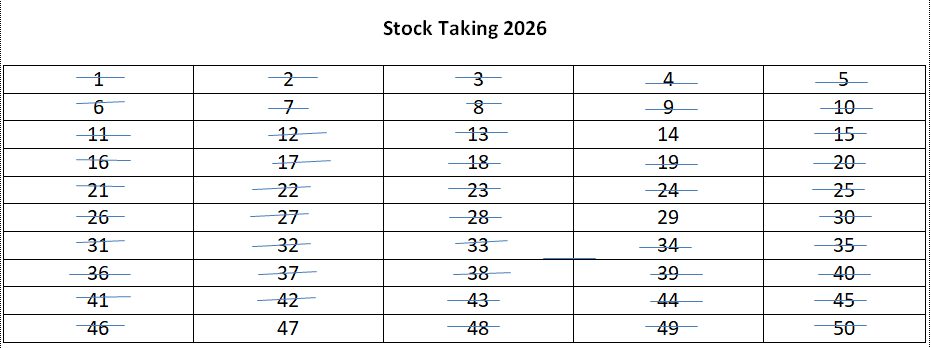
In the mentioned sample, the numbers 14, 29 and 47 have not been crossed out. Therefore, in the year 2024, the books with the following three numbers of the concerned library will be marked as lost books. A complete list of these lost books should be prepared and a proposal should be sent to the authorities for rejection. The authorities will issue a written order for rejection of the lost books as per the rules. The catalogue cards and shelf list cards of the rejected books should be removed from the catalogue cabinet and a rejection seal should be given in the remarks column against the rejected books in the Accession Register. The rejection order and the lost books should be preserved in the list of books.
4. Write Accession Number Method:
In this method, the Accession Number is not written or printed on a white paper beforehand. In this case, two workers will start working on each shelf as before. One will look at the books on the shelf and say the Accession Number and the other will write it on his white paper. After writing the Accession Number of all the books in this way, the numbers will be arranged in numerical order and written later. After sorting, the books with those numbers that cannot be found will be marked as lost proposals. In this method, caution must be exercised in both saying and writing the numbers because if the Accession Number is not spoken correctly or written correctly after hearing it, stock taking may be incorrect. Below is a sample of it:
Stock Taking 2026
| 1 | 2 | 3 | 4 | 5 |
| 6 | 7 | 8 | 9 | 10 |
| 11 | 12 | 13 | — | 15 |
| 16 | 17 | 18 | 19 | 20 |
| 21 | 22 | 23 | 24 | 25 |
| 26 | 27 | 28 | — | 30 |
| 31 | 32 | 33 | 34 | 35 |
| 36 | 37 | 38 | 39 | 40 |
| 41 | 42 | 43 | 44 | 45 |
| 46 | — | 48 | 49 | 50 |
In the mentioned sample, it is seen that the numbers 14, 29 and 47 are missing. Therefore, in the year 2025, the books with these three numbers in the concerned library will be marked as lost books. A complete list of these books should be made and a proposal should be sent to the authorities for their rejection.
The authority shall issue written orders to the buyers of the lost proposals as per the rules. The order of rejection and the list of lost books shall be kept in the record.
Alternative Methods of Library Inventory Checking
In addition to the above methods, stop taking can be done in the following methods. Namely –
A. With the help of separate register with accession number
B. With the help of calculation
C. With the help of duplicate book cards
D. By combining stock talking and shelf arrangement
E. With the help of computer
However, whichever method is followed, library staff need to exercise utmost caution during stock taking. Because if a staff member mistakenly gives another number instead of an accession number or another staff member mistakenly writes or crosses out an expression number instead of one, then the wrong book will be shown in the lost book list. This will defeat the real purpose of stock taking.