Electronic document:
We usually understand a record containing knowledge, information or data or any creative work. For centuries, we have understood handwritten or printed documents as documents. However, in recent times, due to the widespread spread of computer technology, the distribution of electronic documents and readable documents is increasing along with printed documents. Although the history of electronic documents is not long, the presence of these documents is increasing everywhere, starting from libraries and information institutions, which proves the growing importance of electronic documents. Information institutions are working with electronic documents or digital data more and more than before.
Key Characteristics of Electronic Documents
Linda Schamber has identified some important characteristics of electronic documents:
-They can be used to do various things very easily, such as ‘cut’ and ‘paste’ these documents, rotate or bend them at different angles, etc.
-With the help of hyperlinks, various connections can be created inside or outside the document. That is, it is possible to connect one part of a document to another document and one document to another.
-Can be converted from one form to another very quickly and easily.
-Can be searched extensively and effectively with search software.
-Can be sent from one place to another instantly.
-Infinite retrieval is possible, at least numerous copies of a document can be made quickly and effectively, without any loss in quality or in any way. That is, no matter how many copies are made, all the quality remains the same.
Advantages of Electronic Documents in Modern Information Institutions
Modern information professionals have to work with various electronic documents while doing information management work. Currently, the number of electronic or digital documents in information institutions is increasing day by day and this increase will continue in the coming days. In order to properly manage electronic documents and perform search and retrieval work efficiently, we need to have an idea about the mutual relationships between different electronic documents. Because a document is not an isolated island, it has direct or indirect relationships with other documents and based on this relationship, we can find these documents.
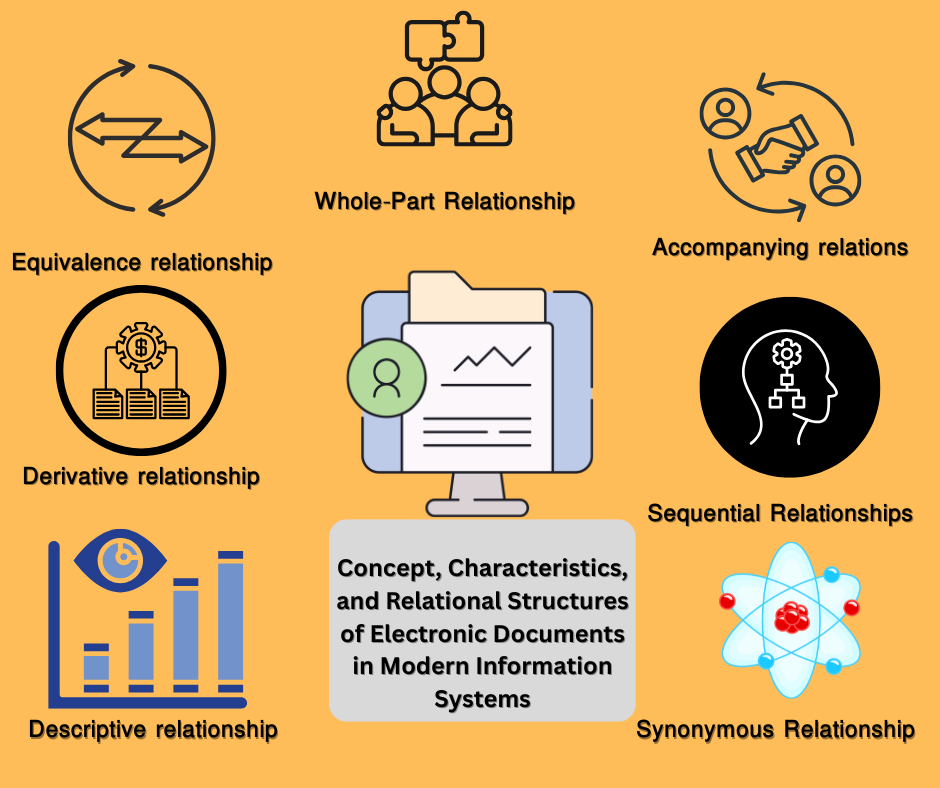
Seven Types of Relationships Between Electronic Documents Explained
We can think of seven different relationships between electronic documents. These are:
1. Equivalence relationship:
This is the relationship between an exact copy of a work of art. Examples include copies, fax copies, photocopies, microphones, etc.
2. Derivative relationship:
This is called a horizontal relationship. This relationship is between a document and other documents based on it. For example, different versions of a document, reprints, translations, etc.
3. Descriptive relationship:
This is the relationship between a work of art and its description, criticism, evaluation and review. This also includes annotated editions, casebooks, synopses, etc.
4. Whole-Part Relationship:
This is called a vertical relationship. This relationship exists between a work of art and one of its parts. For example, a work taken from a collection or a work of art included in a series can be said to be a work of art. The relationship between a book and one of its chapters is also a whole-part relationship.
5. Accompanying relations:
This relationship occurs when two documents replace each other. These two documents can be of equal status to each other. For example, a book and its supplement), or they can be semi-subordinate (for example, a book and its index).
6. Sequential Relationships:
This relationship is also called a chronological relationship. In this relationship, this document is related to another document in time, one comes before, the other comes after. For example, in the case of serial publication, one is published before which one is published after, there is a relationship between different books in the same series.
7. Synonymous Relationship:
This type of relationship occurs when two or more publications, although not directly related, share one or more common characteristics. These may include the same author, the same title, the same subject, or another characteristic that serves as an access point for information retrieval. Unlike the other six types of relationships, there is no significant correlation between the documents in a synonymous relationship; the similarities are merely coincidental.
Electronic documents have transformed information management by enabling instant access, easy modification, unlimited reproduction, and powerful search capabilities. Understanding the different relationships between electronic documents helps information professionals organize, retrieve, and manage digital resources more effectively. As digital content continues to grow, recognizing these relationships will remain essential for efficient knowledge organization and access in modern information institutions.