To know about secondary entry, first we need to know what is devotion or its types or how many types. The collection of a library is the library catalog or list. While creating this catalog, care is taken to ensure that the reader can easily understand the list and find the desired book. Entry is the listing or registration of a book under a title, through which a reader can easily find the book. While creating a catalog, it must be taken care that this catalog is easy to understand not only by the library staff but also by the readers. Otherwise, the purpose of the library will not be successful. The main purpose of a library is the fair and proper use of books. Even after the book is in the library, if the reader cannot find the book just because he does not understand the catalog, then there is no point in cataloging it. The prerequisite for creating a proper catalog is to create proper entries for the books. That is why entries are of immense importance.
Different people have given different definitions of entries.
They are quoted below:
- A heading under which a record of a biographical entry is represented in a catalogue or list, also in the case of a world entered under titles that title….-AACR1.
- A record of a bibliographical entity in a catalog or list –AACR1
AACR2 has two accompanying entries.
- An access point of a Bibliography record under which the record may be searched and identified – AACR2.
- a record of an item in a catalogue- AACR2
Margaret mann ‘Entry ‘that, the registry of a book in a catalogue. Marty Bloomberg thinks, A record of a book (or other materials ) in a catalog there maybe entries for author, title, and subjects.
B.S. Wyner said, A representative of a Bibliographic record at a particular point of a catalog. There can be one or more entries for any heading.
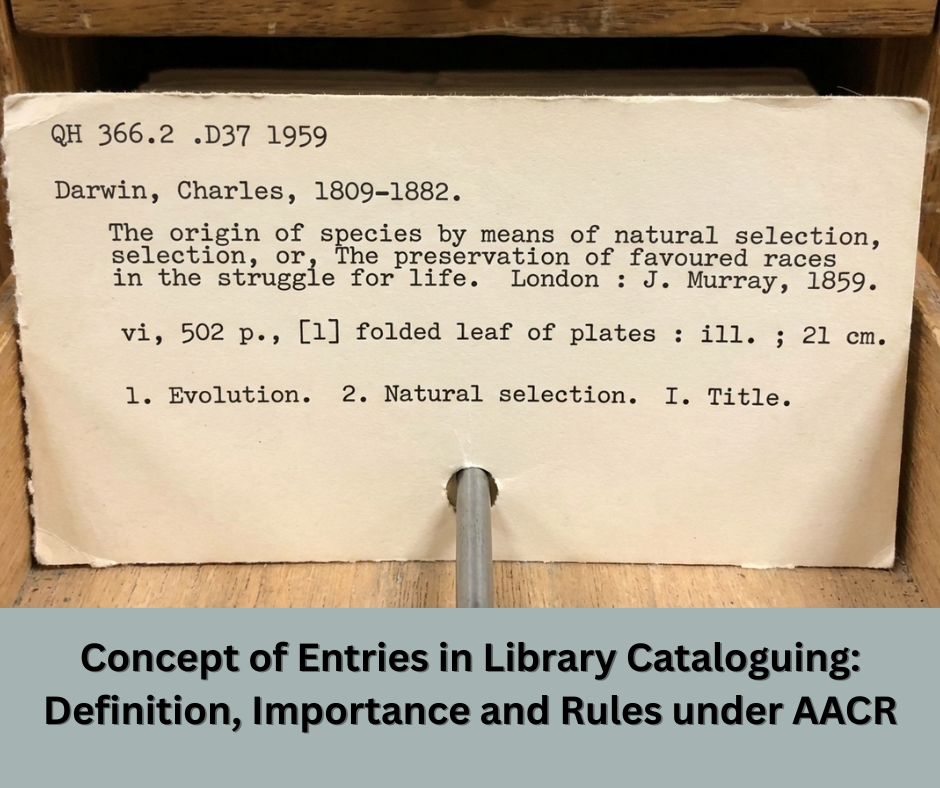
Necessary information included in the catalog:
During the creation of the catalog, various important information is included from the book. Experienced librarians or catalogers know very well where the necessary information can be found in the book. This is discussed below:
See entries for the name of the book:
Let’s say the name of a book is ‘Society, Library and Communication’. After creating the writing in the title of the book, the card will be arranged with the word ‘Society’. If someone searches for a book on library or communication, then he will not find the news of this book. Therefore, separate title writings should be created with ‘Library’ and ‘Communication’ and below each one should be written “See Society, Library and Communication”. Then the reader will find that book.
See entries for book details:
Some of the topics of books are very complex. In this case, the librarian does not have to just write “See”. If necessary, “See more” should be written. For example, the name of a book is: Sports Laws. This topic will be:
1.Sports 2. Sports Laws. Now if someone searches for information on cricket, hockey, football by looking at the catalog, he will not find this book. Therefore, an entry like this should be written: Cricket, See more Sports etc.
Rules for creating Entries:
Everyone is dedicated to the importance of entries in cataloging. For this reason, every librarian has to follow a specific rule (code) while creating writing. Today, the Anglo American Cataloguing Rules or AACR for short is being followed all over the world. Originally, AACR was published in 1967 under the supervision of ALA, a joint effort of ALA, Library of Congress (LC), and Canadian Library Association (CLA). The second edition of AACR was published in 1978 simultaneously from Chicago, Ottawa, and London. The first is known as AACR 1 and the last is known as AACR 2.
We know that there are many different types of entries and writing. Each should have its own rules of scientific preparation. That is why AACR has developed separate rules for each type of writing. The general principles of writing by AACR are as follows:
1. Entry should be under the author or principal author when one can be determined.
2. Entry should be under editor when there is no author or principal author and when the editor is primarily responsible for the existence of the work. 3. Entry should be under a compiler on the title page in the case of a collection of words by various authors.
4.Entry should be unders title in the case of other works where authorship is diffuse, indeterminate or unknown-AACR1(P-9.1-)
Entries are the backbone of an effective library catalog because they transform a collection of books into an accessible, user-friendly system for readers. By following standardized rules like AACR, librarians ensure consistency, clarity, and multiple access points—author, title, and subject—so users can locate materials easily. Ultimately, proper entries fulfill the core purpose of a library: enabling fair, accurate, and efficient use of its resources.