
Principles of Book Classification:
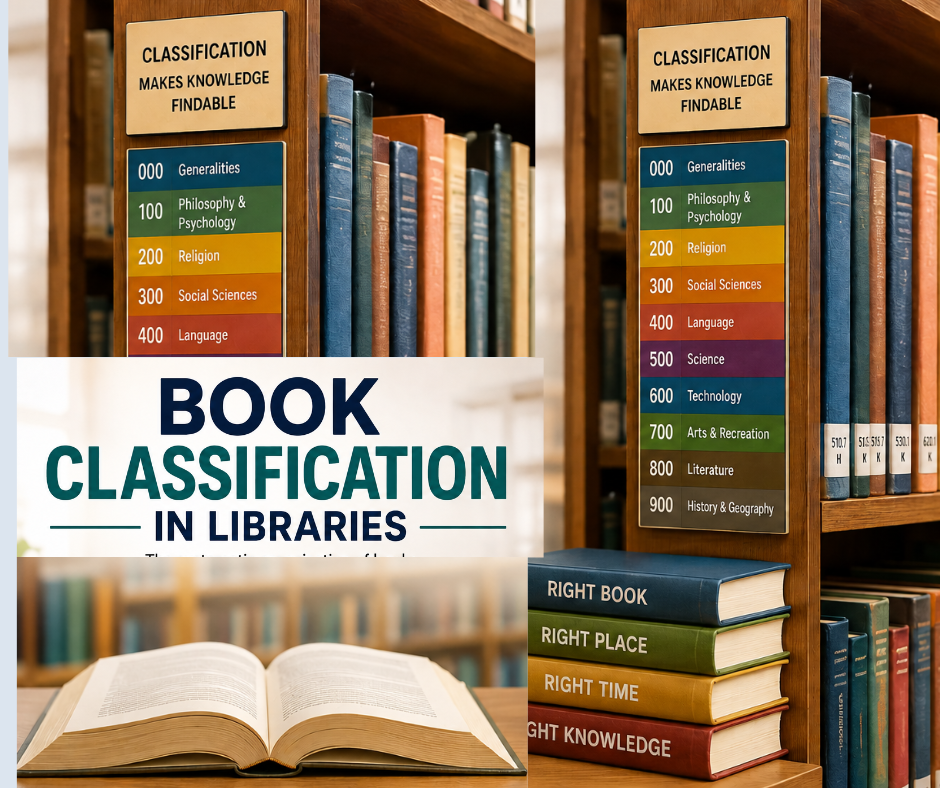
How many principles are followed in the work of arranging books in libraries. These principles necessarily ensure maximum convenience. Principles are followed in book classification in case of use to solve the problems that arise during arrangement. From a practical point of view, many have expressed different principles of book classification. Among them, the widely used Code for Classifiers prepared by W.S. Merrill is particularly noteworthy. If this code is prepared based on the DDC system, it is an indispensable helper book for those who use this scheme.
Book Classification Rules
- First, the subject matter class number of the book should be given, then the form class number of the perspective from which the subject is written. For example -Science Dictionary (503.03). Similarly, the country class number should be added to the subject matter. For example -Economic Geography of England = (Economic Geography)(England)(330.9)(42)=330.982. But there are some exceptions in the literature class where there is form.
- If a book contains two or more subjects, then the class number according to the first globalization is preferable, unless the other subject is of special significance. Moreover, the class number should be given based on the number of pages discussed or the library in which the book will be used, judging by the needs of the users.
- If there are more than two subjects and the subjects are related, the class number of the main book in which they are included should be given. For example, Sound Science 534, Light Science 535 and Heat Science 536. The class number of the book containing such subjects will be 530, i.e. Physics, which includes the said three subjects.
- It is better to categorize books written on a combination of many subjects in a general classification. For example, encyclopedia-030.
- Books related to translation, criticism, financial book reviews, etc. should be kept with the category number of the main subject.
- Personal descriptions (political, economic, social images) If they are related to a specific event and place, then the description of the related subject or place should be given the category number, not the person’s adjective. For example, Log of a U Boat commander 1914-1918, the book’s category number will be the related history, i.e. 940.4512. Likewise, Tenzing’s conquest of Mount Everest. This book is not Tenzing’s autobiography, but the class number will be the travelogue.
- If the personal biography is closely related to international events, countries, leaders or any national events, then the number of the history of that country should be given. For example, the number of the book titled Palmerton and the policy of Queen Victoria, will be the history of England during the Victorian era, i.e. 942.05.
- For books related to biography, it is better to give priority to the class number of life in public and school libraries and to give priority to the class number of the subject in other libraries, such as university and special libraries. For example, the biography of Shakespeare will be different in the case of public libraries and in the case of special libraries.
A. If the content of the book is written for a special class of readers. Then the class number of the main content should be given 510. Exception, if the main content is not completely changed for the reader somewhere. For example – “How to treat mental illness” the class number of the book will be Medical Science (616.8) or Mental Science (132).
B. Before giving the class number of any book, it should be noted whether there is any other copy of the book in the library or if so, what number was given to it, unless there is a serious mistake in the previous case, the class number of the previous book should be given the new book number. Because it is easy to imagine that there cannot be two different numbers for the same book. Otherwise, the reader class will suffer and the library will be in bad name. Maintaining consistency is the main feature of an ideal library.
C. If necessary, the classifier can make a decision different from the class number given in the schedule or create a new class number. However, it is advisable to write it on the card with the reason and save it in an authority file. Because anyone who comes later can follow the previous and future by looking at this file.
9. It is better to write the class number of the book in the language in which the content of the book is written. That is, in the case of content written in English, it should be written in English, and in the case of books in Chinese, in Chinese. The advantage is that by looking at the class number written in the book, it is understood in which language the book is written. For example, History of Science-509.
10. Reference, research and special libraries should be arranged very carefully according to specific subjects. For example, a book titled “Air Operations in World War II” can be kept in any public library, small college or general library with the numbers 355,355.48,909. But in a special library its number will be 940.554.
There are several other principles of book classification. It is always necessary to remember that the purpose of classification is to ensure the proper and successful use of library collections. The purpose of classification is to arrange the library collections in a simple and scientific manner while maintaining the subject and category-wise relationship. If there is actually too much classification or if the use of the collection is hindered due to the effect of proper classification and it is not available on time, then the purpose of establishing a library is not successful. Finally, it can be said that in practical terms, proper classification requires knowing the principles of classification, which can be easily understood in the light of the above-mentioned principles.
Related posts:
 Library Administration Policies: Principles and Practices for Effective Library Management
 Reference Librarian: Definition, Functions, Duties, and Bibliographical Services
 Systems Librarian: Definition, Responsibilities, Duties, Qualifications, and Essential Professional Skills
 International Information Systems (IIS): Concepts, Types, Acquisition, Processing, and Dissemination of Information