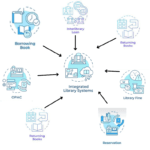
Circulation in any library is a very specific, regular, and routine task. Through this, the relationship between the customers and the documents can be controlled, and they can be kept informed about them. This system includes lending documents, returning them, imposing fines or taking other measures if they are overdue, storing them, etc. Therefore, circulation can be managed and controlled in an automated system. Since the post-World War I period, many mechanical systems have been invented for circulation. Examples include Dickman’s book charging system, Geld’s system, etc. However, among these, the McBee punch card system, which was introduced in various American libraries in the 1930s, was the most efficient and acceptable mechanical circulation system. This McBee card contained the book’s author’s name, title, postal number, customer’s name and address, etc. Then a hole was made on the edge of the card according to the return date. In this way, many cards were held together with the help of a clip. Then, to know which book would be returned on a particular day, a thin wire rod was inserted into the hole with that particular date. The specified documents would be read on that needle, and the rest would fall down. In this way, the McBee card system could be easily developed for circulatory systems. By the 1950s, some librarians had tried to use computer-generated lists and single-record devices. At that time, the ABM 375 data collection terminal was the most popular single-record device. Therefore, the IBM 375 computer was used for the automated circulation system. By the 1960s, many libraries began to process circulations using first- and second-generation computers. After 1970, online automatic circulation systems began using third-generation computers.
Main functions of an automated circulation system:
An automated circulation system performs the following main functions.
A . To obtain various information regarding the location and status of documents;
B . To identify all those documents that are considered for a particular class of customers;
C . To keep all the information related to storage and to release the document from storage after a certain period of time;
D . To renew the loan;
E . To send reminders for the repayment of the loan when the due date has passed;
F . To prepare a list of customers who have violated the contract and to take action against them;
G . To collect fines and keep an account of them;
H . To collect various statistics related to circulation and prepare reports;
I. Control and management of special categories of customers and special documents;
To do all these tasks, the automated circulation system basically has to manage and maintain three files:
1. Customer information file;
2. Document information file;
3.circulation information file
The customer information file mainly contains six types of elements –
A. New Customer: Here the customer is classified into categories such as student, teacher, researcher, employee, etc. and various information about them such as their name, address, class education, preference list, email, telephone number and even a picture is collected and stored if necessary.
B. Membership Browsing: If any information of the customer is changed, it is used to correct, modify, and make changes.
C. Member List: It has two parts. The first part contains information about the member code, name, status, available facilities, etc. The second part contains various information related to the member’s address.
D. Member Inquiry: This element is listed according to the member code or category or status. With the help of this, any member can be quickly identified and information about him can be collected.
E. Customer Report: In this, a collective report of all customers or various types of statistical or composition-based reports can be easily created about a specific customer.
F .Summary Report: Complete circulation report can be easily generated using this component.
Six essential components of Circulation
The document information file consists of six essential components, each serving a unique purpose to enhance user interaction and data retrieval. These components are:
a. New Information Component: This section is dedicated to presenting the latest updates and additions to the document database. It allows users to quickly identify and access new entries, ensuring that they stay informed about the most recent developments.
b. Detailed Document Browsing: This component offers an intuitive interface for users to navigate through a wide array of documents. Users can explore various categories, filter results based on specific criteria, and quickly drill down into the content they are interested in, making the exploration process efficient and user-friendly.
c. Document List Component: This feature presents a comprehensive list of all available documents, complete with essential details such as titles, authors, publication dates, and tags. Users can sort and organize this list to view documents in a manner that suits their needs, facilitating easy access to important information.
d. Detailed Document Report: This component generates in-depth reports for individual documents, summarizing key insights, findings, and relevant data. It includes visual aids such as graphs and charts to help users better understand the content and context of each document, enhancing comprehension and analysis.
e. Detailed Document Search: This powerful search tool allows users to query the document database with specific keywords or phrases. It employs advanced algorithms to deliver precise results, helping users locate the exact documents they need quickly, thereby saving time and improving productivity.
f. Document Summary Report: This component provides concise summaries of documents to give users a quick overview of the content. It highlights main ideas, conclusions, and significant points, making it easier for users to grasp the essence of documents without having to read them in full.
Together, these components create a robust framework for managing and accessing document information efficiently.

The Key Function of Circulation:
The circulation component is designed to streamline seven key functions, enhancing overall efficiency:
1. Lending—facilitating the borrowing process;
2. Returning—managing the return of items;
3. Listing – providing organized listings of available materials;
4. Reporting – generating detailed reports for analysis;
5. Circulation Search – enabling users to easily locate items;
6. Sending Reminders—ensuring timely notifications for returns;
7. Summary Report – offering concise overviews of circulation activities.
By effectively utilizing these functions, we can improve operations and better serve our users. The above elements may vary depending on the software. In such a day, using a sophisticated barcode system, circulation can be processed very quickly. Various reports can be generated in an instant. Moreover, using Radio Frequency Identification (RFID) technology, documents can be automatically retrieved from an unmanned desk or returned to a drop box.