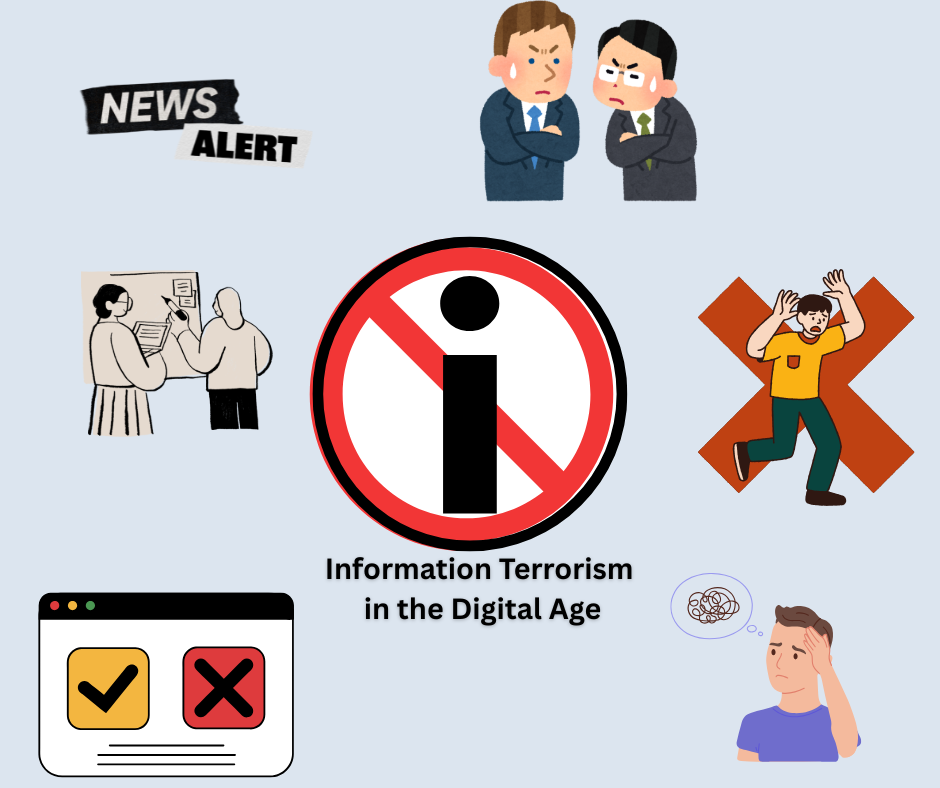
In information science, “information terrorism” refers to the deliberate use, manipulation, or disruption of information to instill fear, confusion, instability, or social harm. It is closely related to concepts such as misinformation, disinformation, information warfare, cyber threats, propaganda, and the manipulation of information systems.
How Information Terrorism Can Destroy Society
1. Spreads Misinformation and Disinformation
False or deliberately manipulated information can spread rapidly through social media, websites, and messaging platforms. People may make decisions based on this inaccurate information, leading to confusion and distrust.
2. Destroys Public Trust
Repeated exposure to false information can erode trust in governments, media, libraries, universities, researchers, and other information institutions. This weakens the information ecosystem within society.
3. Creates Fear and Panic
False reports about disasters, disease outbreaks, security threats, or other emergencies can provoke unnecessary panic and irrational behavior.
4. Manipulates Public Opinion
Information can be selectively presented or distorted to influence people’s political, social, or economic opinions. From an Information Science perspective, this highlights how access to information and information literacy impact decision-making.
5. Attacks Information Infrastructure
Cyberattacks targeting databases, libraries, archives, government information systems, or communication networks can render crucial information unavailable or unreliable, threatening its availability, integrity, and accessibility.
6. Damages Information Integrity
Information Science emphasizes the importance of accuracy, authenticity, reliability, and integrity. When information is intentionally altered or fabricated, users find it difficult to distinguish between trustworthy and harmful information.
7. Increases Social Polarization
Algorithms and coordinated information campaigns can repeatedly expose individuals to biased or emotionally charged content. This can deepen divisions between different social groups.
8. Threatens Knowledge Institutions
Libraries, archives, universities, research organizations, and information centers play a vital role in preserving and providing access to knowledge. Manipulating or destroying their information resources can damage collective memory and hinder scholarly communication.
An Information Science Perspective
A useful way to understand the problem is through the following process:
Information → Processing → Dissemination → User Interpretation → Decision → Social Impact
If information is corrupted at any stage, the consequences can resonate throughout society. For example:
- False information → Rapid dissemination → Public confusion → Wrong decisions → Social panic → Loss of trust
Therefore, Information Science not only studies how information is collected, organized, stored, retrieved, and disseminated, but it also plays a critical role in ensuring the quality, authenticity, security, and ethical use of information.
How Information Science Can Help Prevent Information Terrorism
1. Information Literacy
Information literacy is the ability to recognize when information is needed, find relevant information, evaluate its quality, and use it effectively and ethically.
In the context of information terrorism, information literacy helps people avoid becoming victims of false or manipulated information. An information-literate person does not immediately believe or share a sensational post. Instead, they ask:
- Who created this information?
- Is the source trustworthy?
- What evidence is provided?
- When was it published?
- Can the information be confirmed by other reliable sources?
- Is the information presented objectively?
Example:
Suppose a social-media post claims that a particular institution has suddenly closed. Instead of immediately sharing it, an information-literate user checks the institution’s official website and reliable news sources.
2. Media and Digital Literacy
Media literacy involves understanding how news, advertisements, social-media content, videos, and other media messages are created and distributed.
Digital literacy goes further by helping people use digital technologies safely and effectively.
These skills are important because information terrorism can exploit digital platforms to distribute:
- Fake news
- Manipulated photographs
- Deepfake videos
- Fake websites
- Misleading headlines
- Artificially generated content
- Coordinated propaganda
People with strong media and digital literacy are more likely to recognize suspicious content and question emotionally manipulative messages.
Example:
A video may appear to show a public figure making a particular statement. Digital literacy encourages the viewer to investigate whether the video is authentic, edited, or artificially generated.
3. Fact-Checking and Source Evaluation
Fact-checking means verifying whether a claim is supported by reliable evidence. Source evaluation means examining the credibility, authority, accuracy, currency, and purpose of a source.
Before accepting information, users should consider:
Authority: Who produced it?
Accuracy: Is there evidence?
Currency: Is it up to date?
Purpose: Why was it created?
Relevance: Does it actually answer the question?
A particularly important principle is source triangulation—comparing information from multiple independent and trustworthy sources.
Example:
If a social-media account claims that a major event has occurred, users can compare the claim with official announcements, reputable news organizations, academic sources, or other authoritative records.
4. Reliable Metadata and Information Organization
Metadata is essentially information about information. It helps describe, identify, organize, discover, and manage information resources.
Examples include:
- Author
- Title
- Publication date
- Subject
- Keywords
- Source
- Document type
- Identifier
Reliable metadata makes it easier to determine where information came from, when it was created, and what it represents.
Poor or deliberately misleading metadata can make false information appear more credible or make authentic information difficult to discover.
Example:
A digital photograph without reliable information about its creator, date, location, and provenance can easily be taken out of context.
5. Information Security
Information security protects information from unauthorized access, alteration, destruction, or disruption.
Three fundamental principles are often represented by the CIA triad:
- Confidentiality – information is accessible only to authorized people.
- Integrity – information remains accurate and is not improperly altered.
- Availability – authorized users can access information when needed.
Information terrorism may involve attempts to compromise information systems, manipulate databases, destroy digital records, or disrupt access to critical information.
Example:
If a library’s digital repository is attacked and its records are altered, users may receive incorrect information or lose access to important scholarly resources.
6. Digital Preservation
Digital preservation involves maintaining digital information so that it remains accessible, authentic, and usable over time.
This is particularly important because information can disappear through:
- Hardware failure
- Cyberattacks
- Accidental deletion
- Software obsolescence
- File corruption
- Platform shutdown
- Deliberate destruction
Preservation also helps maintain society’s collective memory.
Example:
Government documents, historical records, research data, newspapers, photographs, and cultural materials may need to be preserved in trusted digital repositories.
This makes it harder for important information to be permanently destroyed or manipulated.
7. Authentication and Verification
Authentication helps establish whether information, a person, document, or system is genuine. Verification involves checking whether a claim or information object is supported by evidence.
In the digital environment, authenticity is particularly important because content can be easily copied, edited, fabricated, or generated.
For example, verification may involve examining:
- Original sources
- Publication history
- Digital signatures
- Document provenance
- Author identity
- Timestamps
- Independent evidence
- Multiple authoritative sources
Example:
Before accepting a document as an authentic government announcement, users should verify whether it actually originated from the relevant official institution.
8. Ethical Information Practices
Information professionals have an ethical responsibility to promote accurate, fair, responsible, and lawful use of information.
Ethical information practices include:
- Avoiding deliberate misinformation
- Respecting intellectual property
- Protecting user privacy
- Avoiding manipulation
- Providing equitable access to information
- Citing sources properly
- Protecting confidential information
- Correcting inaccurate information
Ethics becomes especially important when information can influence people’s decisions or cause social harm.
Example:
A librarian should not deliberately alter information to favor a particular organization or suppress reliable information without a legitimate reason.
9. Critical Thinking
Critical thinking is the ability to analyze information objectively rather than accepting claims automatically.
It requires people to:
- Identify the claim.
- Examine the evidence.
- Identify assumptions.
- Consider alternative explanations.
- Compare different sources.
- Distinguish facts from opinions.
- Reach a reasoned conclusion.
Critical thinking is particularly important because information terrorism often attempts to exploit emotion rather than reason.
Sensational headlines such as “Everyone is in danger!” or “Share this immediately!” can encourage people to react before verifying the information.
10. Responsible Information Dissemination
Finding accurate information is only part of the process. How information is shared is equally important.
Responsible dissemination means sharing information:
- Accurately
- Contextually
- With appropriate sources
- Without unnecessary exaggeration
- Without deliberately creating fear
- With respect for privacy
- With corrections when errors are discovered
For example, a librarian, researcher, journalist, educator, or content creator should verify important information before distributing it to a large audience.
Example:
Instead of:
“BREAKING! This shocking news is confirmed! Share immediately!”
Responsible dissemination would provide:
“According to the official announcement published by [source] on [date], the following information has been confirmed…”
The second approach provides context, provenance, and evidence.
Information Science can play a major role in protecting society from the harmful use of information. Its responsibility is not simply to store and retrieve information, but also to help ensure that information is accurate, authentic, accessible, secure, organized, preserved, and used ethically.
Ultimately, the goal is to create an information-resilient society—one in which people can identify unreliable information, verify important claims, protect valuable information resources, and make informed decisions even in an environment of manipulation and information threats.