Long Range Reference Service:
Describing the importance of this service, S. R. Ranganathan said, ‘This is a service that no library is completely without. However, this service is a special feature of research libraries of learning centers, universities and business institutions. The information sources used in the ready reference service, including dictionaries and encyclopedias, are used in the long range reference service, but this service is not limited to these sources. Any source can be used, starting from books, reports, periodicals, websites, remote databases. Providing this service can take from half an hour to a day, or even a whole week.
Nature of Information Provided by Long Range Reference Service:
Unlike ready reference service, long range reference service does not only provide activity or fact-checking information, but also provides various types of specialized information. The questions asked in this service are complex in nature. Long range reference questions can be divided into the following categories:
A. Recent information inquiries: Printed reference books do not contain the most recent information. Therefore, periodicals, daily newspapers, online news sites, etc. can be used for updated information.
B. Specialized inquiries: Many times, readers want specialized information and the answer to it is not available in general reference books. In this case, subject-based research can be useful for the occasional reader.
C. Information sought from a specific perspective: In these cases, reference books are not considered very useful. Books and subject-based websites are more reliable in providing the information sought from a specific perspective.
Need for long-range reference services:
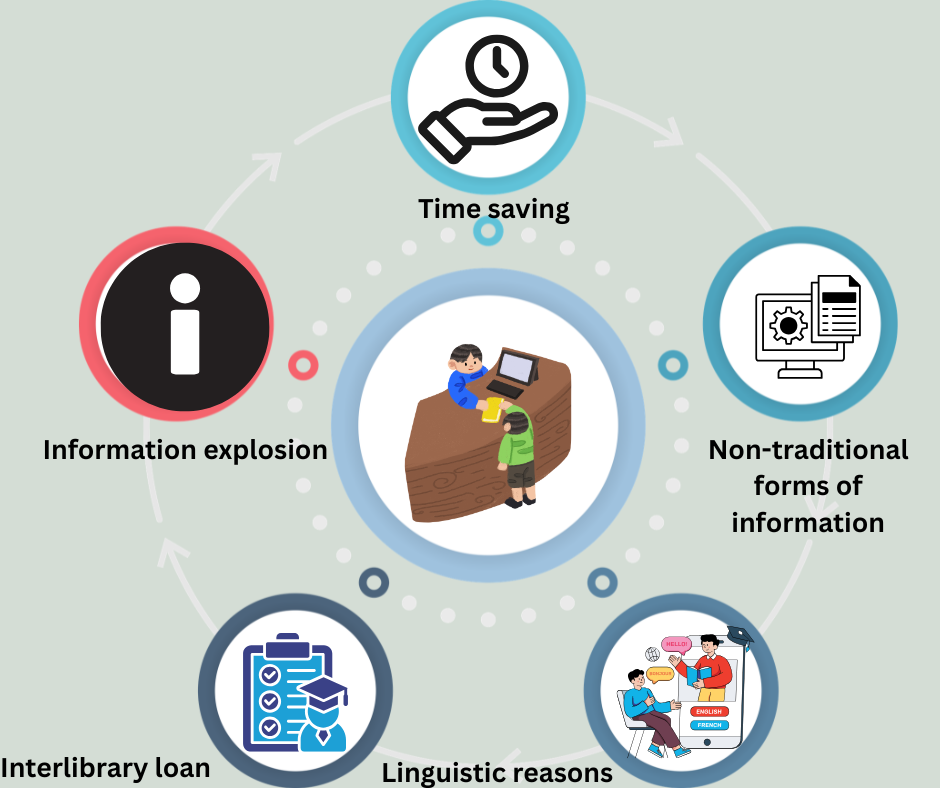
The need for long-range reference services in libraries is increasing for various reasons. These include:
A. Information explosion: In this era of information explosion, researchers take temporary help in cataloging and summarizing information for their own subject. However, these are temporary and often delayed in terms of content and time. Again, the desired information may not be published in a journal on its own subject but in a journal on another subject. Therefore, he has to rely on long-range reference services for information search.
B. Time saving: By engaging the responsibility of information search or literature search in the hands of the reference librarian, the researcher can save a lot of time. He can use the extra time for research or reading. By saving the time of these readers, the reference librarian can play a role in strengthening his research work.
C. Non-traditional forms of information: In libraries, information is available not only in traditional forms like books or military documents, but also in the form of leaflets, technical reports, microfilms, etc. Such non-traditional information materials often escape the attention of researchers. The responsibility of the reference librarian is to introduce readers and researchers to various non-traditional information materials.
D. Linguistic reasons: The researcher may not know the languages in which the various information materials of interest are available. For this reason, the reference librarian is responsible for arranging the translation of various unnecessary information of the researcher as per his needs.
E. Comprehensive collection through interlibrary loan: In order to provide the best service to the readers, many libraries are participating in interlibrary cooperation recently. As a result, libraries are able to rely on interlibrary cooperation to provide long range reference services.
Method of providing long range reference services:
Like ready reference services, long range reference services have to be provided in three stages: preparation, service and assimilation. These are discussed briefly:
1. Preparation:
First, the reference librarian should understand the subject on which the service is being provided. He can acquire this knowledge by reading several representative works on that subject. He will try to understand the scope, trend, development and relationship with other subjects on that subject.
The reference librarian should also know the type of readers to whom the information service will be provided and their informational style. Sources of information include general books, reference books, periodicals, newspapers, conference proceedings, audio-visual materials, websites, electronic databases, etc. Research references and unpublished sources of information should be known. In addition, research that is ongoing in universities and research laboratories should be kept up to date. The three types of bibliographic materials that one should be more aware of are:
a. Bibliographies of related subjects, especially abstracting and indexing journals, annual reviews, and journals in which reviews are printed;
b. Homogeneous bibliographies, which include not specific subjects but larger branches of knowledge;
c. Broad-based bibliography that includes all branches of knowledge but is limited to a specific type of publication, such as periodicals, articles, abstracts, etc. These may also be limited to a specific time period or geographical area.
Information should be collected based on the needs of the reader or by anticipating the needs in advance. To answer questions that may arise in the reference test or in the future, information resources should be searched in the library and outside the library. New and old issues of journals, rare books and reports, websites, blogs, etc. can also be considered important sources of information. In addition, reference librarians should maintain contact with subject experts, researchers and scholars, so that if information is not available in the library or conventional sources, help can be sought from them.
Librarians need to be sufficiently qualified to provide long-range reference services. There are two aspects to this qualification, one is related to library and information science, the other is related to research. Reference librarians should be appointed to various subject-based positions in large libraries. As a result, it will be possible to provide services in an effective and systematic way.
2. Service: There are three steps in providing service –
A. Understanding the needs of the reader:
The needs of the reader must be understood correctly. Different types of readers come to the library. Some come to fulfill a simple inquiry, while many come who seek help in solving a complex problem. Although macro documents are more helpful in fulfilling the information needs of the general reader, advanced and expert readers will need multi-dimensional analysis of micro documents. That is, by analyzing various aspects of a subject, the necessary content has to be found and the information has to be consolidated and analyzed at various levels.
B. Document Search: At this stage, the reference librarian will try to create a class number for the subject on which the reader is looking for information. The search will then begin. He will search the library catalogue, bibliography, indexing and abstracting journals, documentation lists at the local or national level, etc., and thus try to create a chronological list of recent microdocuments.
C. Document Delivery:The next step is to provide the reader with the desired information or information material. If it is not in the form of a complete book, it can be brought through the interlibrary loan or downloaded from the web or external database. In addition, if translation or photocopying is required, the reference librarian will have to make that arrangement.
3. Assimilation: Like the ready reference service, in long range reference service, the librarian will have to assimilate information from various sources and also learn from his own experience. In addition, he will have to constantly share knowledge and experience with other colleagues. He will give suggestions to improve the collection and service of each library from the extract of his own experience. In addition to knowledge about bibliography and an idea of the recent progress in various subjects, he should have an idea about the collection of various libraries associated with his library. An updated record of the research work being conducted under the long range reference service should be maintained in such a way that help can be obtained from them whenever necessary.