MARC is a term coined by the principal of Machine Readable Cataloging. Machine readable means that a special type of machine computer can read, interpret, and perform various operations on cataloging records in databases.
Components of a Bibliographic Cataloging Record:
We know that a cataloging record is a special type of bibliographic record that is usually displayed on a catalog card. This record usually contains the following information;
a . Description of the information content
b. Main entry and additional entries
c. Subject headings
c. Class number or postal number
A MARC is a standard or value that is followed to express and exchange bibliographic and similar information in a form that is usable by computers.
Sample of MARC Bibliographic Format:
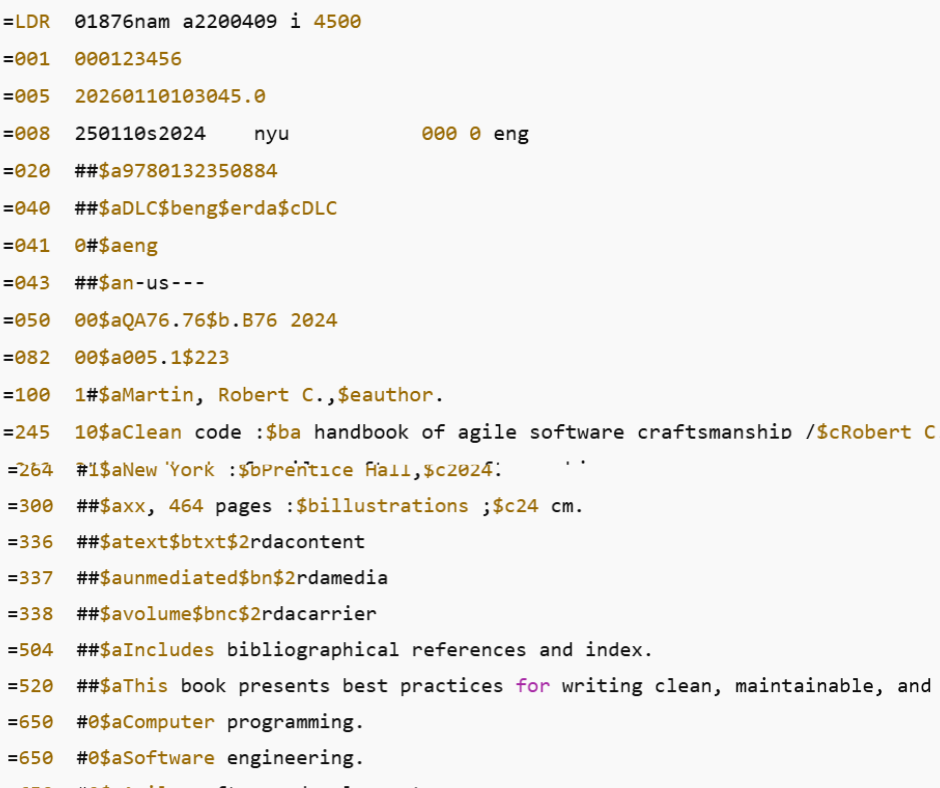
Main fields of MARC:
The total number of fields in MARC 21 is 182, and 1711 subfields have been defined so far. Below is a description of the notable fields of MARC 21:
1.Fixed Fields: Leader and 008 fields are fixed fields, which are defined by the number of letters or characters. These fields provide information about the record, its content and cataloging standards. Since the information in the leader and 008 fields is appositionally fixed, this information can be indicated by the position of the character. For example, LDR /17 is interpreted as the record being complete, while 008/35 – 37 contains a three-digit language code, which indicates the language of the original record.
2. Oxx: There is no common formula for the numbers starting with ‘0’. These fields contain administrative and symbolic information, call numbers, and information about the record. Some common fields starting with ‘0’ are:
a .002-ISBN
b .035 – OCLC Control Number. This is a number used for each record in the OCLC database, which can be used to perform a comprehensive search of the OCLC database.
c .041 – Language of the item. In the case of translated items, the original language may also be specified.
d .043 – Location where the item is located.
e .050 – Call number or postal code, following the Library of Congress classification system.
f .090 – Local (used by the library concerned) call number
3. 1xx: Fields beginning with “1” are main entry fields. Each MARC record can have only one main entry. This will contain the name of the person or entity that created the associated content. This could be a person, an organization, or even a conference or event. The names used in this field are usually also used in the corresponding 7xx field; that is, the name that would be used as the main entry in the 100 field could be used as an additional entry in another record in the 700 field. The two most commonly used 1xx fields are:
4. 2xx: Fields starting with ‘2’ contain information about the overall title, edition, publisher, etc. Some of the most commonly used fields under 2xx are as follows:
245: Title of the material
246: Any other form of the title
250: Edition
260: Place of publication, publisher and date
5. 3xx: Fields beginning with ‘3’ contain information about the physical structure and characteristics of the material. Many fields in this series are used to describe audio-visual, digital, and other non-book materials. Some of the most commonly used 3xx fields are:
300- Format description (information about page numbers, volumes, decorations, etc.)
336,337 and 338- Content, carrier and media type, which are recently added MARC fields. Created specifically for the new cataloging standard RDA (Resource Description and Access)
6. 4xx: Currently, only one 4xx field is in use – 490. However, some 4xx fields may be found in older records that are no longer used. The 490 field contains information about the series of the item.
7. 5xx: Fields starting with ‘5’ contain various types of annotations or notes related to the related material. These notes may include bibliography, table of contents, restrictions on use of material, audiovisual specifications, summary or any other notes. Some of the most commonly used 5xx fields are as follows –
500-General notes
504-Bibliographic notes
505-Content notes
510-Citation/reference notes
520-Summary notes
8.6xx: Subjects beginning with ‘6’ and sometimes also form information. Personal and corporate names used in the 1xx and 7xx fields may also be used in the 6xx field, if any of their contents are considered subjects. Some of the most commonly used 6xx fields are –
600-Personal name (subject)
610-Corporate name (subject)
651-Geographical name (subject)
9. 7xx: Fields beginning with ‘7’ are used to provide additional assistance in accessing the related material. For example, additional geographical information, information about other people or organizations involved in the creation of the material, etc. are given in the 7xx field. Among these, the 7xx fields are also used as ‘linking fields’, which connect other materials related to the related collection. For example, linking a specific issue of a periodical to other issues of a periodical or linking a printed collection to an electronic version. Some of the commonly used 7xx fields include
700-Additional entry (personal name)
710-Additional entry (corporate name)
740-Additional entry (any organizational title of the material, which may be considered necessary by users. )
751-Additional entry (geographical name; name of a specific place related to the material. The 043 field contains the main place name)
10.8xx: Fields beginning with ‘8’ have a variety of uses. For example, providing alternative means of accessing material used in series titles, providing information about the location of related material in the library, or providing information about the file, etc. Some of the commonly used 8xx fields are as follows –
830-Official title of series
852-Location of material in the library
11. 9xx: Fields starting with ‘9’ are still considered obsolete as these fields are not currently used in any MARC records. However, these fields are seen in older records where these fields are used to provide administrative or local information.
MARC Record Format provides a structured, standardized framework that enables computers to store, interpret, and exchange bibliographic information efficiently across libraries worldwide. By organizing data into fixed and variable fields, MARC ensures consistency, accuracy, and interoperability in modern library cataloging systems.