Medieval Books:
The survival of books was threatened by foreign plunderers with the fall of the Roman Empire in the fifth century. Fortunately, the clergy resisted this threat and became a stable agency committed to preserving books. The monks, having recovered the necessary books related to the doctrine or tradition and full of scholarship, took refuge in the monastery or church. During the reign of “St. Benedict”, the monks of the monastery, who enjoyed reading books and were far from social chaos and surrounding conditions, were given the responsibility of producing books for a certain period of time and they were established as libraries for the use of the community.
The development of medieval books serves as a reflection of a nation’s culture, as a country’s libraries and books often indicate its cultural richness. By examining the evolution of libraries and books, we can gain insights into the cultural knowledge of both the religious and Muslim worlds. For thousands of years, human civilization and culture have played a vital role in the advancement of society. As human civilization expanded and culture progressed, libraries began to emerge. In earlier times, these libraries did not consist of books since writing materials were not readily available; instead, information was recorded using various materials or unique cultural symbols.
After the fall of Rome in the 5th century, Europe entered a Dark Age that lasted for about 1,000 years. During this period, the power of Dark Age poetry helped preserve the cultural legacy of Greece and the knowledge from that advanced era. The significant institutional achievements of the Middle Ages, often associated with educational reforms, were the monasteries, which played a major role in this process.
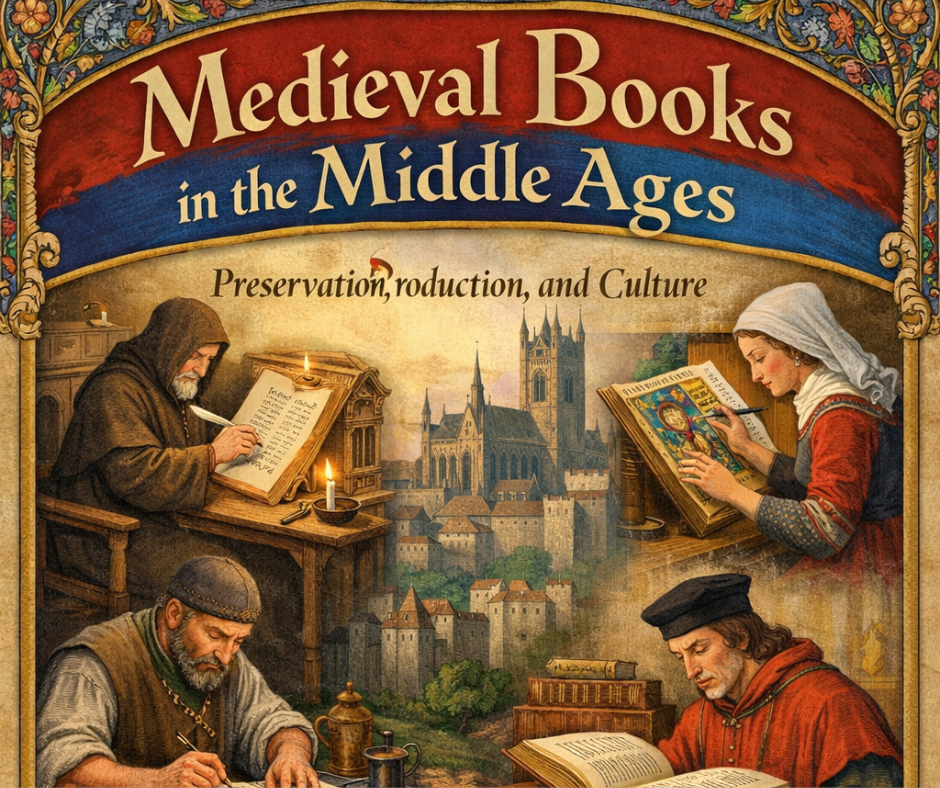
Before 500 AD, books were replaced by vellum and parchment, and the rolled book gave way to the codex. From then on, until the invention of printing, the laborious process of writing and binding books by hand was followed. Monasteries, regardless of the sect, usually had workshops for libraries. Here, books were copied, decorated, and bound. After the original text was copied, the pages went to an artist monk. He decorated the large letters with various designs and pictures. If these pictures were in red ink, they were called bublications, and the artist was called a bublicator. Sometimes the parchment or vellum was dyed.
The Lintisfern Gospel in northern England, made around 700 AD, is now in the British Museum as a specimen of this period. The Book of Kells, one of the four gospels copied at the Abbey of Iris around 800 AD, is one of the most beautiful. It is one of the most beautiful books ever made. The bindings of the books made in the monastery were also perfect. The books were bound with leather and cloth. Sometimes gold and silver were used. The bindings or metal rings used to hold heavy books together were sometimes set with precious stones. The covers of large books were made of wood. These were then wrapped in leather or cloth and then in parchment and vellum. The leather bindings had pictures of designs. The designs were usually called Blinds. Sometimes, more valuable books were chained to the table. They were also tied to a long chain so that the book could be easily moved to the next table.
Classification of Medieval Books: A Detailed Overview
1. Books Authored During the Middle Ages or Within the Church Context
– This category encompasses a wide array of texts produced between the 5th and 15th centuries, reflecting the prevailing social, cultural, and theological currents of the time. These works often include historical narratives, philosophical treatises, and legal texts, significantly shaping medieval thought and societal structures.
2. Religious Texts in the Middle Ages
– Predominantly rooted in Christian doctrine, these works include sacred scriptures, theological commentaries, liturgical texts, and hagiographies documenting the lives of saints. They served not only as spiritual guides but also as instruments of teaching and moral instruction for believers.
During the medieval period, libraries affiliated with religious institutions such as churches, monasteries, and universities were instrumental in the preservation and dissemination of knowledge. Monastic scribes meticulously edited and copied manuscripts, ensuring the survival of classical and contemporary works alike. These libraries became vibrant centers of learning and culture across various regions, including North Africa, Egypt, and the Iberian Peninsula—particularly in the famous city of Cordoba. Notable hubs also emerged in England, Italy, Baghdad, and throughout the Muslim world, stretching from Persia to the western fringes of Spain. Each of these centers contributed uniquely to the evolution of medieval literature and scholarship, reflecting the rich tapestry of cultures and ideas that characterized the era.
Preservation of Medieval Books:
The question of the survival of books arose with the fall of the Roman Empire in the fifth century, when foreign plunderers became a threat. Fortunately, the clergy resisted this threat and, as a stable agency, their existence was certainly curtailed. The priests took refuge in monasteries or churches, retrieving necessary scholarly books related to mutual doctrines or traditions.
Readers and custodians of medieval books: In the sixth century, during the reign of ‘St. Benedict’ (d. 685 AD), monks who enjoyed reading books, located away from social chaos and interpersonal situations, were given the responsibility of producing books for a certain period of time and they were established in libraries for the use of society.
By the end of the Middle Ages, books were recognized for their decorative artistry and beauty. The finest medieval manuscripts rivaled any modern works in terms of decoration and binding, even surpassing the total number of modern manuscripts. The evolution of medieval books primarily focused on written and religious texts.