What is a Feasibility Study in System Development?
To develop a system, all the things or software that are needed are verified or tested in different ways or in different ways, which is called a feasibility study. Before conducting a feasibility study to develop a system, you must first know the answers to three things or questions. For example –
a) Always choose the good thing;
b) After verifying various aspects, what will be the benefit of the thing that is taken;
c) The thing that is taken must have qualities. Before conducting a feasibility study, the feasibility study must be conducted by considering the three judgments:
Types of Feasibility Analysis
1. Economic feasibility:
The financial aspect must be considered, whether the work that will be done or the bad thing that will be taken will be profitable at all? That is, the cost must be in harmony with the benefit.
2. Technical feasibility:
Whether the system development can be done with the existing computer or whether it will be profitable or more convenient to purchase a new one should be considered.
3. Reliable behavior:
If the current system is developed or the library is computerized, there may be obstacles due to the absence of workers. Therefore, when implementing a new system or developing an old system, care should be taken so that no one is harmed. At the same time, special attention should be paid to ensuring that everyone can work with the same reliability as before.
Feasibility Study Process (Step-by-Step)
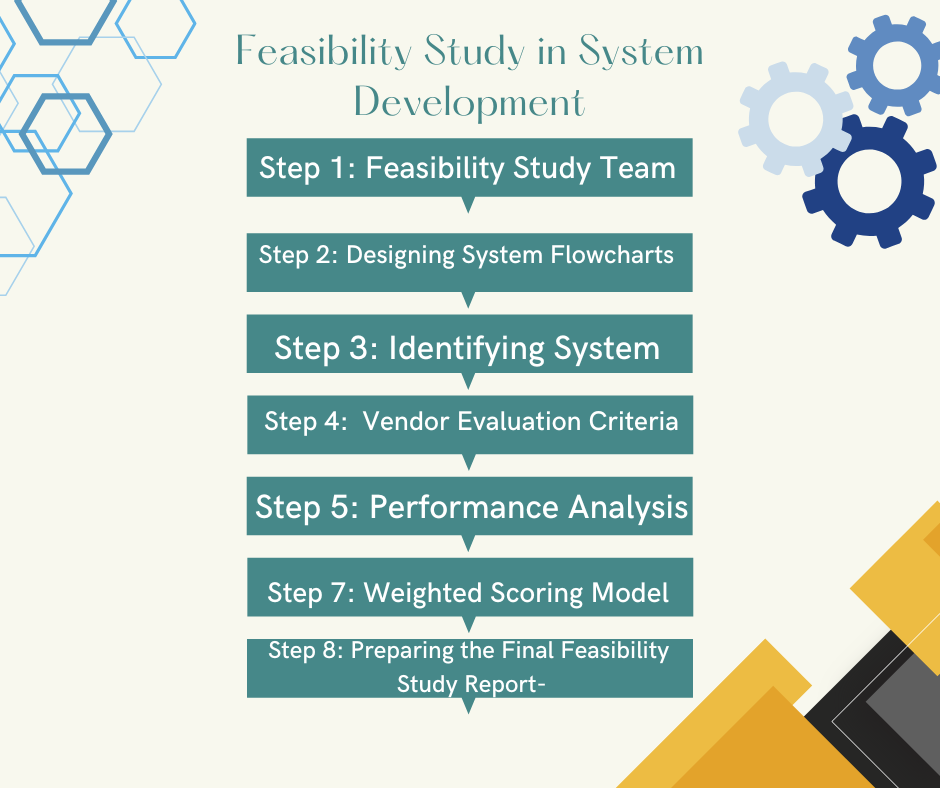
Eight steps need to be followed to conduct a feasibility study, namely:
Step 1: Feasibility Study Team (Team Formation and Roles) –
A feasibility study group needs to be formed. Not everyone is skilled in all tasks. Moreover, many people are needed to do system development. When a feasibility study is conducted, everyone in the group must be present. They will help the system analyst. They will all decide on a software together and discuss it several times. Or, they will have to sit down with an expert and discuss the software and find out how to use the software. The people in the group will decide.
Step 2: Designing System Flowcharts for Data Movement-
Creating a flow chart, how to follow the information, so everyone will create a chart together. Then everyone in the group will sit down and see if a flowchart is needed, if so, whether it has been done correctly, whether there are any mistakes, etc.
Step 3: Identifying System Requirements and Technology Needs-
After making the data flowchart, the information collected will be identified by what method and what kind of machine, and what kind of computer or software will be needed for it. After identifying, those who provide computers will have to tell those who provide computers that I need this type of computer. Then they will consider the pros and cons and provide the appropriate computer.
Step 4: Hardware Selection and Vendor Evaluation Criteria-
After selecting a computer, the software must be evaluated. What are the features of the computer? The features are as follows: a) How much memory or storage capacity does a computer have? How many computers will have less storage capacity?
b) In which language is the code written in the software we have selected?
c) Is there a lot of source code? If there are any criteria, we will benefit in the future and then we have to buy it.
d) What will be the price of the computer that will provide it?
e) How many computers have been sold so far by the said company.
f) How long has this computer been sold, that is, whether the suppliers have previous experience in supplying computers, before placing a work order, that is, whether the company has a good reputation.
Step 5: Software Evaluation and Performance Analysis-
The features must be evaluated. There are two ways to evaluate, first qualitatively and secondly quantitatively. Quality, namely how much work it can do, how quickly it can do it, how quickly it can be understood or used, etc. Quality judgment must be seen to see whether the price is right.
Step 6: Qualitative and Quantitative System Evaluation Methods-
If after the evaluation it is felt that the evaluation cannot be done properly, then the weight performance and cost data must be evaluated. For example:
| Performance factor | Weighting Rating | IBM Score | |
| System accuracy | 5 | 4 | 20 |
| Response Time | 1 | 2 | 02 |
| User friendly | 2 | 3 | 06 |
Step 7: Weighted Scoring Model for System Performance Assessment
Among these three, the one that is more important should be given more marks and the one that is less important should be given less marks. You should give marks knowing how much it might cost and how important the criteria of each one are. Then you should give a score by rating it. However, you should know the ratings that will be given well.
Step 8: Preparing the Final Feasibility Study Report-
Feasibility study report should be written. After conducting various types of computer tests, the report should be written and submitted to the administration and shown to those for whom it has been done. The administration can assume this report to be correct. It can also improve it. If there is any command, then he can give it. The report should be written in the following sections.
a) Cover letter:
There will be a cover letter where the subject on which the report has been written is presented to the administration.
b) Title page:
There will be a title page where all the reports will have a clear title.
c) Table of contents:
The table of contents will have the correct instructions on which page which subject is written.
d) Problem list:
The faults and errors that the current system has, i.e. the problems, should be highlighted and the benefits that will be gained if the next system is developed should be discussed.
e) Cost and benefit analysis:
The cost of the computer, i.e. how much will be spent on the new system and whether it can be profitable in this context, etc. should be written with logic.
f) Recommendation garland and conclusion:
After the evaluation, a gift and recommendation garland should be given about which can be accepted after giving your own opinion about the evaluation.
g) Computer description:
The description of the computer should be presented in front of him at a glance.
h) Acknowledgement:
Who has helped him in this work should be mentioned.
i) Appendix:
The reasons for choosing or evaluating the computer should be mentioned.
If you can do the above tasks correctly and in a phased manner, the implementation will be forced or the work will be implemented by you.