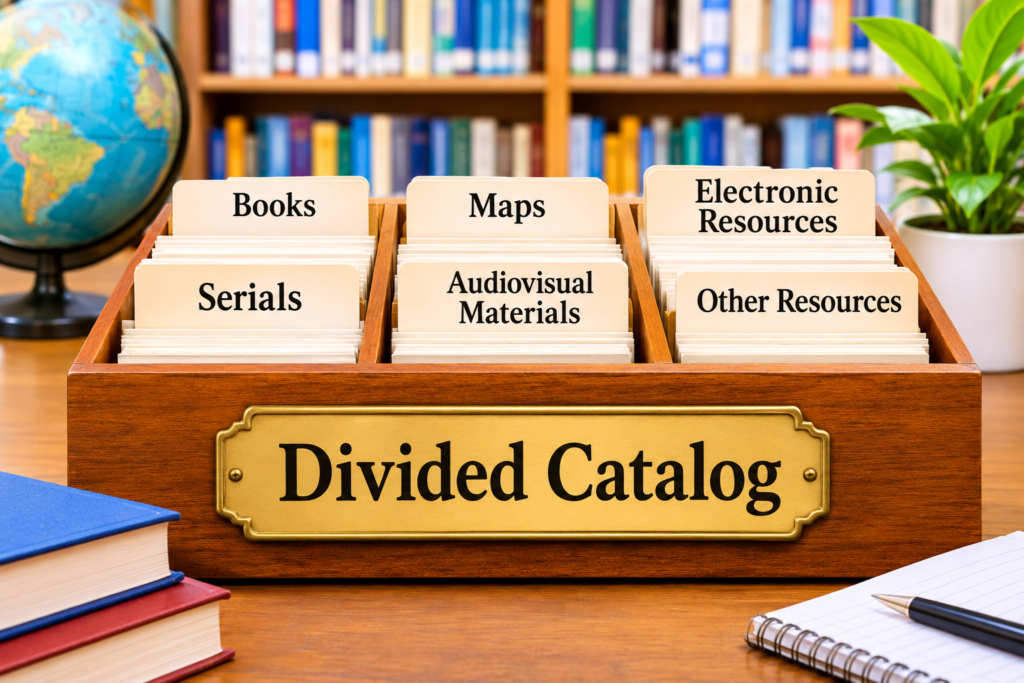
The term “divided” refers to being split or separated. In the context of a library, a “divided catalog” is a system where catalog entries—representing the library’s collection—are organized into distinct categories based on author, title, and subject. Specifically, a divided catalog organizes entries alphabetically within separate sections or cabinets, categorized by these three criteria.
In this system, the entries for library materials are split into two main sections: one for authors and titles, and the other for subjects. For example, an entry for a book written by a specific author would be placed in the author section, while entries about that author or their work—created by other writers—would be found in the subject section.
To establish a divided catalog, a card catalog system is required; it is not possible to implement a divided catalog without using cards. This system is essential for providing high-quality service to library users.
A divided catalog is a specialized library cataloging system designed to enhance organization and accessibility by separating entries into distinct files or sequences, rather than compiling them into a single alphabetical list. This system effectively streamlines the retrieval of information, making it easier for patrons and librarians alike to locate specific resources.
Structure and Format of Divided Catalog
1. Author and Title File:
– This sequence organizes books based on the names of authors and the titles of their works.
– Each entry is methodically arranged in alphabetical order, allowing users to efficiently search for publications by their favorite authors or specific titles.
2. Subject File:
– A separate sequence dedicated to categorizing items based on subject headings.
– Libraries may opt for a straightforward alphabetical arrangement or a more structured classified system, which groups similar subjects together, making it easier for users to find related materials.
3. Three-Way Split:
– In some libraries, a three-part cataloging format is utilized, which includes distinct sequences for Authors, Titles, and Subjects.
– This tri-part division provides an extensive framework that caters to diverse research needs, allowing users to choose their path based on their search criteria.
4. Alphabetical Order:
– All entries within each individual section are meticulously organized in alphabetical order.
– This systematic approach not only aids in quick access but also enhances the overall efficiency of the cataloging process.
Detailed Advantages of a Divided Library Catalog:
1. Organized Structure:
– The divided library catalog is designed with clear sections for authors, titles, and subjects. This organized framework allows users to navigate each category easily, ensuring that different types of information are kept distinctly separated for better clarity.
2. Reduced Size of Segments:
– By separating entries into distinct categories, the overall size of each catalog segment is minimized. This reduction in segment size simplifies the filing process, making it easier for library staff to manage and update the catalog, which ultimately enhances the efficiency of library operations.
3. Time Efficiency:
– Users benefit from the streamlined nature of the catalog, as they can quickly find the information they are looking for without unnecessary delays. This efficiency not only improves the overall user experience but also encourages more frequent use of the library’s resources, contributing to increased patron satisfaction.
4. Subject-Based Searches:
– Given that many library users search for materials based on specific subjects, a catalog organized by subject proves to be particularly effective. This categorization enables users to access a wealth of resources related to their topic of interest without sifting through unrelated entries.
5. Easy Bibliography Creation:
– When there is a need for compiling bibliographies that focus on particular subjects, a divided catalog makes this process straightforward. Librarians can efficiently gather and organize relevant resources, providing users with curated lists that are easily accessible and tailored to their specific research needs.
6. Quick Access to Desired Books:
– The system allows users to locate a desired book swiftly if they have prior knowledge of the author’s name, the book title, or the subject area. This targeted searching reduces frustration and enhances the likelihood of users finding the exact materials they need.
7. Collection Assessment:
– A divided catalog enables library staff to assess the strengths and weaknesses of the collection across various subject areas. By analyzing which sections are well-stocked and which may be lacking, librarians can make informed decisions about future acquisitions and resource allocation.
8. Informed Decision-Making:
– With a comprehensive view of the library’s holdings organized by subject, library administrators can engage in strategic planning for collection development. This informed decision-making process ensures that the library meets the needs of its users and remains relevant in an ever-evolving educational landscape.
9. Easy Updates:
– The segmented approach of a divided catalog facilitates easier maintenance and updates. Library staff can focus on specific sections that require new additions or changes, ensuring that the catalog remains current and accurately reflects the latest resources available.
10. Comprehensive Benefits:
– The divided catalog leverages the benefits of traditional author, title, and subject catalogs, combining them into a holistic system that addresses diverse user needs. This multi-faceted approach not only enhances the browsing experience for patrons but also supports the library’s mission to promote access to information and facilitate learning for all users.
Alternative to Dictionary Catalogs:
– The divided catalog serves as a superior alternative to traditional dictionary catalogs, which tend to mix all types of entries into a single, overwhelming alphabetical list.
– By addressing the crowding issues present in those systems, the divided catalog enhances user experience and facilitates a more logical and organized way to access library resources.
The divided catalog system offers a structured and efficient way to manage library resources, ensuring that users can easily navigate through a wide array of information while keeping the catalog well-organized and accessible.
Structure & Arrangement of Divided Catalog
– Separate Files: This system typically divides entries into at least two primary sequences—one dedicated to authors and titles, and another focused on subject headings. This separation makes it easier for patrons to locate specific materials without sifting through unrelated entries.
– Alternative Splits: In some libraries, a more nuanced three-way split is employed. This further categorization creates individual files for authors, titles, and subjects, enhancing ease of access. Additionally, certain institutions may combine proper names and titles in one segment while maintaining a separate section for subjects, catering to varied user preferences.
– Color Coding: To facilitate navigation within physical card catalogs, many libraries utilize a system of color-coded labels affixed to cabinet drawers. This visual differentiation serves to clearly distinguish between the author/title section and the subject section, allowing users to quickly identify and access the information they seek.
A divided catalog represents a unique approach to organizing library resources, where entries are categorized into distinct and standalone alphabetical files instead of being intermixed in a single, continuous sequence.