DSpace is software designed for creating institutional information repositories. It is a popular open-source platform that facilitates the development of repositories for knowledge management. DSpace was developed collaboratively by the renowned technology company HP and the Massachusetts Institute of Technology (MIT). With DSpace, users can store, preserve, index, and distribute a variety of digital content, including text, video, audio, and data.
As the volume of digital information continues to grow, DSpace offers an effective way to manage this content within institutions, enhancing both its visibility and usability.
The DSpace software fulfills several key roles:
A. Storage of digital content including metadata;
B. Indexing and searching of stored digital content
c. Overall long-term maintenance.
DSpace has a large number of tools for the proper management of digital content, which users can customize as they wish. As an open source software, DSpace has an active community of developers who are constantly improving it. DSpace is skilled in managing various types of digital content. These contents include – articles, articles, technical reports, conference papers, etc. documents, books, theses, computer programs, visualizations and simulations, various types of models, multimedia materials, bibliographic materials, images, audio, video, digital digital library collections, educational materials and web pages.
Advantages of using DSpace:
DSpace is a turn-key repository system. That is, it can be used to create institutional knowledge bases with little effort. It is so advanced that users do not need much customization. DSpace advantages are as follows:
a. Overall organization and preservation:
Digital content can be easily organized, described, and preserved within the built-in framework of DSpace.
b. Archiving and distribution:
Website information can be easily archived and distributed.
c. Search engine search: With the help of Google and other search engines, content can be quickly reached by the world’s readers.
d. Content identification: Each content can be permanently identified, it never changes.
e. Open source: DSpace is open source software, so it can be used for free.
f. Large number of users: A large number of organizations around the world use DSpace, and these users can get help with technical and management issues as needed.
g. Customization: DSpace can be easily customized and configured to meet the specific needs of the user.
h. Statistics and reports: DSpace provides various types of statistics and reports. These statistics can be arranged in various ways and can be accessed with indicators such as authors, documents, community most downloaded, most read authors, etc.
i. Add-on features: DSpace has a system for adding various types of add-ons or additional features to enhance the user experience.
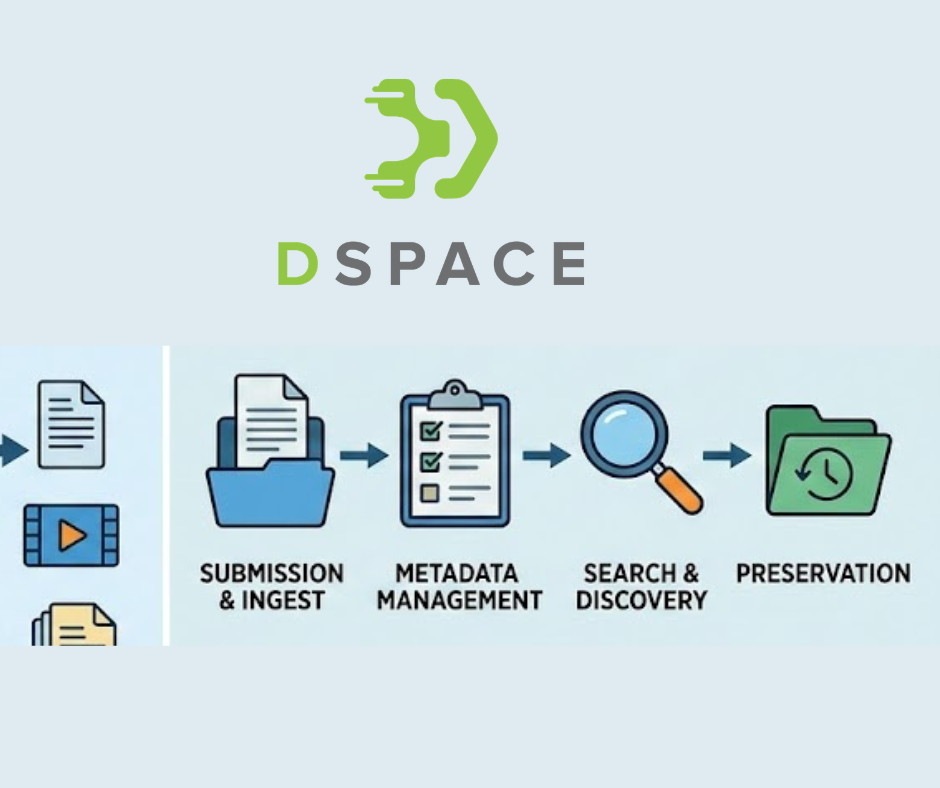
Parts and Functions of DSpace:
The main parts of DSpace and their functions are briefly discussed below:
- Submission: The task of storing a file in DSpace’s database can be easily done through a web-based interface. DSpace has been designed to store various types of aggregates, from simple text to datasets and digital videos.
- Files: DSpace data files are called bitstreams. They can be organized as sets of related files. Each bitstream is accompanied by technical information, including technical structure. This technical information is included with the bitstreams to preserve the datasets for long periods of time.
- Item: An item is made up of related content and its metadata. Each item’s metadata can be indexed for browsing and searching. Items are organized into ‘collections’.
- Community: The highest level of classification of DSpace content is the community. Each community can be formed by different departments, labs, branches, research centers, etc. of an organization.
- Preservation: DSpace is designed to enable long-term preservation of digital content in line with changing technologies, data structures, media, etc.
- Retrieval: DSpace’s end-user interface is designed to facilitate easy search. Once an item is found, the content is viewed in a web browser in a user-friendly manner.
The DSPase source code repository is maintained by a select group of individuals who have the authority to modify the code and release new versions. They collaborate with the global DSPase community to address various issues and enhance the software.